How Prefabricated Offices Improve Workplace Expansion for Growing Businesses in Africa
October 15, 2026
Share At:




Listening Article
AI Summary
As businesses across Africa scale their operations, many quickly outgrow their existing office space, including manufacturing units, logistics companies, construction contractors, and industrial operators. Prefabricated offices help these businesses add functional, professionally planned workspace as they grow, using factory built components assembled on site rather than traditional construction methods. This approach suits industrial sites, construction projects, and commercial operations that need flexible, expandable workspace as staff and operations grow. Timelines depend on office size, design, customization, and site conditions rather than a fixed duration.
Understanding Prefabricated Offices for Business Expansion
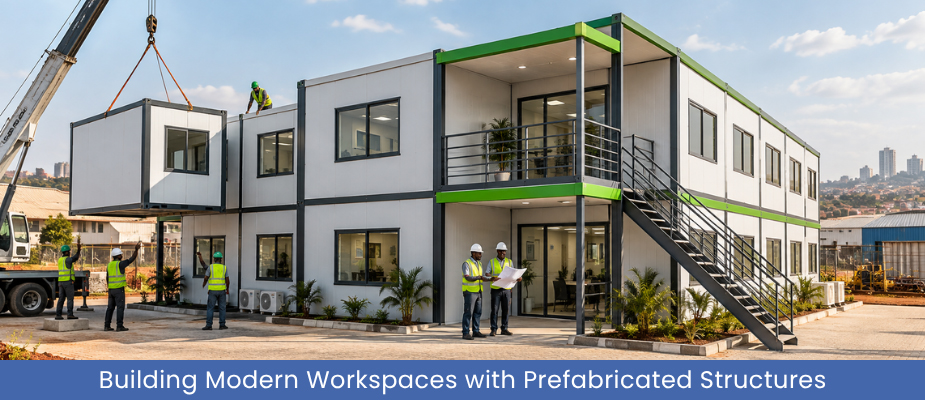
Prefabricated offices are office structures built using factory manufactured components that are assembled on site. Unlike conventional brick and mortar construction, prefab office buildings rely on steel frames manufactured in advance, panels, and modular sections designed for straightforward assembly.
For businesses, this approach offers several practical advantages:
- Workspace can be planned around actual operational needs rather than fixed building constraints
- Structures can be designed as standalone offices or integrated with existing industrial or commercial facilities
- Modular offices can be adapted for single room setups or larger multi department layouts
This flexibility makes prefabricated office structures a relevant option for companies across manufacturing, logistics, construction, and commercial sectors that need workspace solutions matching their pace of growth.
Speak with an Expert
 Call Us Now!
Why Growing Businesses Need Flexible Prefabricated Office Spaces
Business growth rarely follows a predictable timeline. Companies may need to accommodate:
- New employees joining as operations expand
- Additional departments such as finance, HR, or operations support
- Site offices for ongoing construction or industrial projects
- Temporary teams working on specific contracts
Each of these situations places different demands on office layout, location, and size. A business adding a finance team, for example, has different space and privacy requirements than one setting up a site office for a project crew.
Prefabricated offices provide a practical response to these changing requirements. Because components are manufactured to defined specifications, businesses can plan workspace around actual headcount and department needs rather than the fixed dimensions of an existing building. Companies like Build Matt work with businesses to understand these specific requirements before recommending suitable prefabricated office solutions.
How Prefabricated Offices Support Immediate Workplace Growth
Modular offices support day to day business expansion by giving companies a way to respond quickly when workspace needs change. In practice, this means businesses can:
- Add office capacity as soon as new employees join
- Set up dedicated space for a newly formed department without disrupting existing teams
- Establish a professional work environment for a project team at an industrial or site location
- Plan layouts around current staff numbers, equipment, and daily workflow
Because prefabricated office structures are fabricated to defined specifications, businesses can work with the manufacturer to plan layouts suited to how teams operate right now, whether that involves open plan work areas, private offices, or meeting rooms.
Manufacturers can support businesses by helping them plan prefabricated office structures based on their current staffing and operational requirements.
How Prefab Office Buildings Reduce Construction Delays
One of the most common reasons businesses consider prefabricated offices is the desire to avoid the disruption associated with traditional construction. Conventional building projects often involve multiple contractors and extended construction activity on site that can interfere with daily operations.
Prefab office buildings differ from this process in several ways:
- Fabrication away from site: Structural components are manufactured away from the business location, reducing the volume of construction work carried out on site
- Reduced site activity: With much of the fabrication completed beforehand, work carried out on site is generally limited to assembly and finishing
- Installation planning: Site preparation, utility connections, and access arrangements are planned in advance to support a smoother assembly process
- Approval considerations: Local regulatory and permit requirements should be factored into project planning from the outset
It is important to note that actual project timelines vary. Businesses should not expect a fixed installation duration, as several factors influence how long a project takes, including office size, design complexity, customization requirements, and site conditions. Proper planning before installation helps ensure the process runs smoothly.
Custom Prefabricated Office Layouts for Different Industries
Office requirements differ significantly depending on the industry. A manufacturing company may need a compact site office attached to a factory shed, while a logistics business may require a larger administrative block near a warehouse. A prefabricated office shed can also provide dedicated administrative space near manufacturing units, warehouses, and project locations where businesses require practical workspace solutions.
Common layout considerations across industries include:
- Industrial sites: Offices located near factory floors or warehouses for supervisory and administrative staff
- Construction projects: Site offices for project management teams
- Commercial operations: Reception areas, meeting rooms, and staff workstations within a single structure
- Multi department businesses: Layouts that separate departments while maintaining shared access to common areas
Practical workplace layouts should account for staff movement, equipment placement, and future adjustments as teams grow or change. An experienced fabricator can support these varied requirements, helping businesses across industrial and commercial sectors plan office layouts that fit their specific operations.
Applications of Prefabricated Offices Across Africa
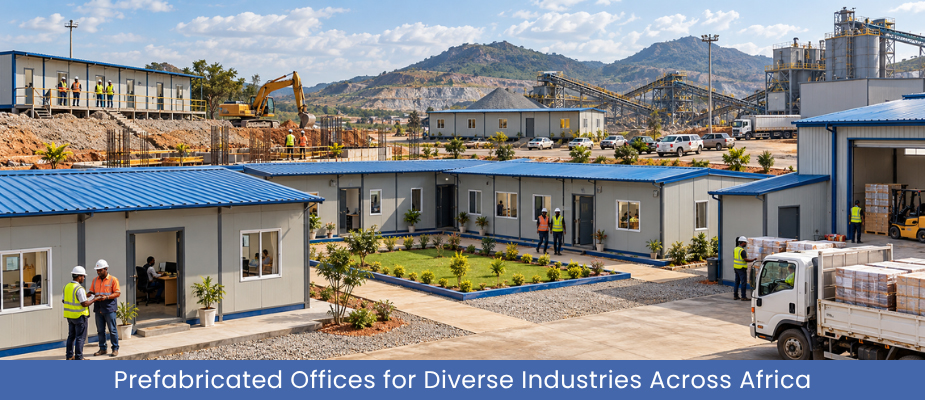
Prefabricated offices are used across a wide range of business settings in Africa. Common applications include:
- Construction site offices for project management teams
- Administrative offices at mining and industrial facilities
- Site or supervisory offices within manufacturing plants
- Administrative blocks for logistics hubs
- Offices attached to warehouses and storage facilities
- Additional workspace for businesses undergoing corporate expansion
These applications span industrial, commercial, and project based settings, reflecting the range of businesses that rely on flexible workspace as part of their broader infrastructure planning.
Temporary Office Solutions for Changing Business Requirements
Not every business requires a permanent office structure. Some companies need temporary office solutions to support:
- Short term project sites
- Seasonal operations
- Pilot locations before committing to permanent infrastructure
- Interim workspace while permanent facilities are being planned or constructed
Temporary office solutions built using prefabricated methods can be arranged to suit these shorter term requirements, offering businesses a way to maintain professional working conditions without committing to long term construction. This is particularly relevant for industrial and infrastructure projects, where site offices are often needed only for the duration of a specific contract.
Planning Expandable Office Structures for Future Needs
Businesses that anticipate continued growth benefit from thinking beyond immediate requirements at the design stage. Expandable office structures are planned with future adjustments in mind, allowing companies to:
- Add sections or modules as staff numbers increase
- Modify internal layouts without major structural changes
- Extend a structure in phases rather than rebuilding from scratch
Factoring these design considerations into the initial planning stage can help businesses avoid starting a new construction project each time their workspace requirements change.
Long Term Benefits of Prefabricated Office Solutions
Beyond design flexibility, prefabricated office solutions provide practical advantages that help businesses manage changing workspace requirements over time:
- Planning efficiency: Office capacity can be aligned with how the business actually grows, rather than committed to upfront
- Space utilization: Modular layouts make practical use of the land or site area available
- Adaptability: Existing structures can be reconfigured as departments, teams, or workflows change
These benefits should be viewed as practical planning advantages rather than guaranteed financial outcomes. Businesses evaluating prefabricated offices should assess these factors based on their own operational context and long term plans.
Selecting the Right Prefabricated Office Solution
Choosing a suitable prefabricated office involves evaluating several factors specific to the business:
- Current and anticipated staff numbers
- Site location and available space
- Layout requirements specific to the industry
- Whether the office is intended as a permanent or temporary solution
- Future expansion plans
Build Matt helps businesses evaluate these factors and plan prefabricated office solutions based on their operational requirements.
We are Fast in Response
Contact Now!
About Build Matt
Build Matt is a Uganda based manufacturer of pre engineered buildings and steel fabrication solutions, established in 2001 and serving clients across Uganda, South Sudan, Rwanda, Burundi, the Democratic Republic of Congo, and Kenya. Alongside warehouses, factory sheds, and industrial structures, Build Matt’s offerings include container offices and customizable prefabricated buildings suited to commercial and administrative use. This makes Build Matt a relevant partner for businesses exploring practical workspace planning support as part of their broader infrastructure needs.
Conclusion
As businesses across Africa continue to grow, the need for flexible, professionally planned workspace becomes increasingly important. Prefabricated offices offer a practical alternative to traditional construction, helping companies add workspace in a way that aligns with their actual operational pace. From industrial site offices to expandable administrative blocks, selecting the right structure depends on a business’s specific layout, industry, and future plans. Businesses planning new facilities or expanding existing operations can discuss their workspace requirements with Build Matt to identify a suitable prefabricated office solution.
FAQs on prefabricated office
A prefabricated office is a workspace structure built using factory manufactured steel frames, panels, and modular sections that are transported to a site and assembled there, rather than constructed entirely on site using traditional building methods. Build Matt designs and fabricates these structures to fit a business's specific staffing and layout requirements.
There is no fixed installation duration. Project timelines depend on office size, design complexity, customization requirements, and site conditions. Build Matt works with businesses during the planning stage to outline a realistic timeline based on their specific project scope.
Yes, when this is planned for at the design stage. Expandable office structures can be extended with additional sections or modules as staffing and operational needs grow. Build Matt can incorporate future expansion into the initial layout so a business is not limited to its original footprint.
Yes, prefabricated offices are commonly used as site offices at construction projects, factories, warehouses, and mining or logistics facilities. Build Matt has experience fabricating structures for a range of industrial and commercial settings across the region.
Build Matt is based in Kampala, Uganda, and serves businesses across Uganda, South Sudan, Rwanda, Burundi, the Democratic Republic of Congo, and Kenya. Businesses outside Uganda can contact Build Matt directly to discuss project feasibility for their location.
It can be either, depending on how it is planned. Prefabricated offices can be arranged as temporary site offices for short term projects or as more permanent administrative structures. Build Matt helps businesses decide which approach fits their operational timeline.

Founder & CEO
Mukesh Patel is the Founder & CEO of Build Matt ltd, specializing in Pre-Engineered Buildings (PEB) and general steel fabrication. With advanced technology, modern machinery, and a skilled workforce, he delivers efficient and high-quality solutions across East and Central Africa, including Uganda, Kenya, Tanzania, Congo, South Sudan, Rwanda, and Burundi.
Recent Blogs
- How to Plan the Layout and Design of a Functional Container Office
- How Prefabricated Offices Improve Workplace Expansion for Growing Businesses in Africa
- Metal Stairs and Railings for Industrial Facilities: Safety, Design and Installation Considerations
- Free Standing Mezzanines vs Building Supported Mezzanines: Which Solution Is Right for Your Warehouse?
- Steel Industrial Rack vs Commercial Rack: Understanding the Key Differences for Businesses