
Read Our Article
Steel Walkways by Build Matt Engineering the Path to SafetySteel Industrial Rack vs Commercial Rack: Understanding the Key Differences for Businesses
August 24, 2026
Share At:




Listening Article
AI Summary
Steel industrial racks and commercial racks serve different storage needs in Uganda. Industrial racks are engineered for heavy loads and high volume warehousing, while commercial racks suit organized storage in retail, offices and lighter business settings. This article explains the practical differences in load capacity, durability, accessibility and installation between industrial racks and commercial racks. Build Matt supplies industrial racks, commercial racks and warehouse storage solutions suited to varied business requirements.
Steel Industrial Rack vs Commercial Rack: An Overview for Ugandan Businesses
Businesses across Uganda are steadily expanding their warehouses, distribution centers, retail outlets and manufacturing facilities. As inventory volumes grow, choosing the right storage system becomes an operational decision rather than a purely aesthetic one.
Two terms frequently come up during this process: steel industrial rack and commercial rack. Although both are used to organize stored goods, they are built for different purposes, load requirements and business environments.
Understanding this difference helps businesses avoid overspending on unnecessary structural capacity or underspending on a system that cannot support daily operational demands. This article explains how industrial racks and commercial racks differ, where each is applied, and how businesses can select warehouse storage solutions suited to their specific requirements. Build Matt works with businesses across Uganda to supply industrial racks, commercial racks and related warehouse rack systems based on the goods being stored and the way a facility actually operates.
Speak with an Expert
 Call Us Now!
What Is a Steel Industrial Rack?
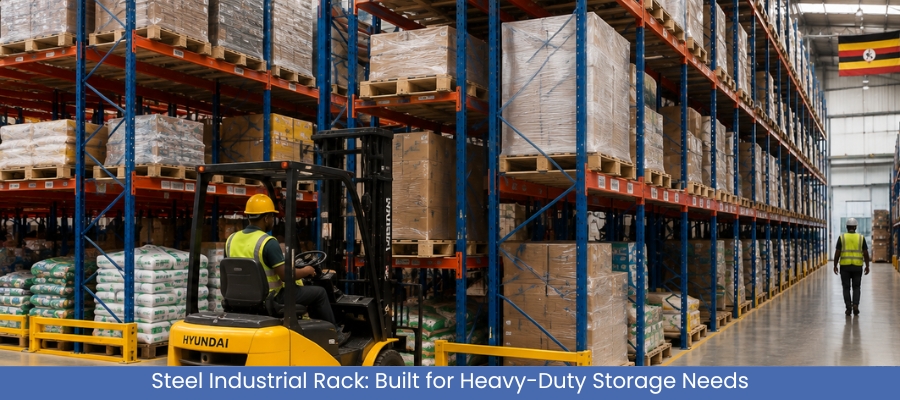
A steel industrial rack is a heavy duty storage structure engineered to hold large volumes of goods, raw materials, pallets or equipment in demanding warehouse and industrial environments. These racks are typically built using structural steel components designed to carry substantial vertical and horizontal loads.
Industrial racks are commonly used in:
- Manufacturing plants storing raw materials and finished goods
- Distribution centers handling palletized inventory
- Cold storage and logistics facilities
- Warehouses using forklifts and material handling equipment
Because industrial racks operate under continuous mechanical handling, their design accounts for factors such as beam strength, upright column capacity, floor loading and seismic or wind considerations where relevant. As an industrial rack manufacturer serving businesses in Uganda, Build Matt develops rack structures based on the stored product type, pallet dimensions and handling equipment used at a facility.
What Is a Commercial Rack?
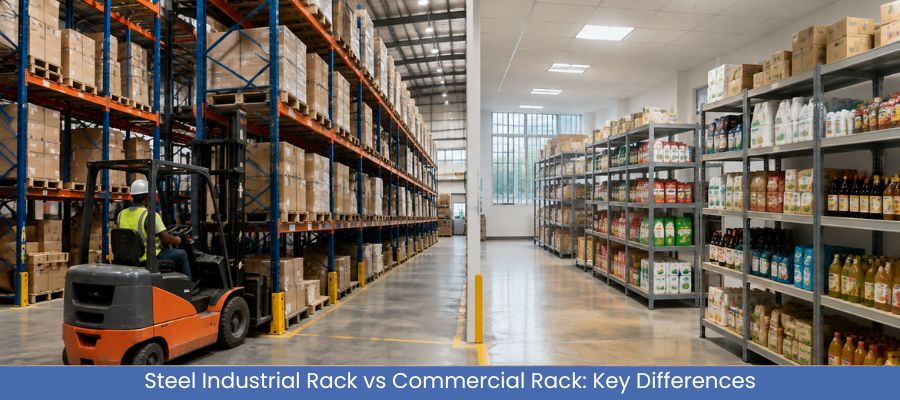
A commercial rack is a storage system designed for organized, moderate load storage in environments such as retail stores, offices, workshops, pharmacies and general business premises. Commercial racks prioritize presentation, accessibility and space organization over heavy load bearing capacity.
Typical commercial rack applications include:
- Retail shelving and display storage
- Office and administrative record storage
- Workshop and small business inventory organization
- Light duty warehouse storage where loads are lower
Commercial racks are generally lighter in construction than industrial racks because the stored goods, handling frequency and load per shelf differ significantly from industrial operations. Build Matt supplies commercial rack systems built to match the storage layout and product range found in retail and office environments across Uganda.
Key Differences Between Industrial Racks and Commercial Racks
The core difference between a steel industrial rack and a commercial rack lies in load capacity, structural engineering and the operational environment each is designed for. Industrial racks support heavier, high volume storage handled by machinery, while commercial racks support lighter, manually accessed storage in business premises.
| Factor | Steel Industrial Rack | Commercial Rack |
|---|---|---|
| Primary usage | Warehouses, manufacturing facilities and distribution centers | Retail stores, offices, workshops and light storage areas |
| Load requirements | Designed for higher load capacity and engineered according to application needs | Suitable for moderate loads and lighter storage requirements |
| Material handling | Commonly used with forklifts, pallet trucks and industrial handling equipment | Mainly designed for manual handling and product picking |
| Customization | Configured based on pallet dimensions, aisle requirements and storage height | Configured according to shelving arrangement and display requirements |
| Durability | Built for continuous industrial operations and heavy duty usage | Designed for regular commercial and business storage applications |
| Accessibility | Requires planned aisles and equipment movement space for efficient access | Provides easy manual access for employees and customers |
| Installation | Requires structural planning, site evaluation and proper installation approach | Generally requires simpler installation with less structural planning |
| Suitability | Ideal for high volume storage, heavy materials and palletized goods | Suitable for organized storage of lighter and varied products |
Choosing between the two systems depends on the goods being stored, the equipment used to move them and the pace at which inventory moves through the facility. Build Matt assists businesses in comparing these factors against actual warehouse operations before recommending an industrial rack, a commercial rack or a combination of both.
Load Requirements and Storage Capacity
Required storage capacity is not a fixed figure. It depends on the type of goods stored, packaging, pallet weight, rack configuration, structural design and applicable engineering requirements for the facility.
Industrial racks are generally specified for higher load bearing needs because they support palletized goods, bulk materials or equipment moved by forklifts. Commercial racks are specified for lighter, evenly distributed loads such as retail products, files or smaller packaged items.
Businesses should avoid estimating capacity based on assumptions. A proper assessment considers the maximum weight per shelf or beam level, the number of storage levels and how the rack will be loaded and unloaded during daily operations. Build Matt evaluates these factors with customers before recommending a rack configuration suited to actual storage requirements rather than a generic capacity figure.
Our Other Product
Prefabrication Steel Structures for WarehousesWarehouse and Business Environments
The physical environment plays a significant role in rack selection. Industrial racks are suited to warehouses and production facilities where forklifts, pallet jacks or conveyor systems are part of daily operations. These spaces typically require wider aisles, reinforced flooring and rack systems built for repeated mechanical contact.
Commercial racks are suited to retail floors, offices and workshops where staff or customers interact with stored goods directly. These environments prioritize visibility, easy reach and efficient use of available floor space rather than heavy mechanical handling.
Some businesses in Uganda operate mixed environments, combining a warehouse storage area with a retail or office front. In such cases, industrial racks and commercial racks may both be required within the same premises. Build Matt supports businesses in planning storage layouts across mixed facilities, supplying industrial and commercial rack systems suited to each functional area.
Quick Response Guaranteed
Email Us Now!
Rack Configuration and Customization Possibilities
Storage systems perform best when configured around the specific goods being stored rather than adapted after installation. Industrial racks can be configured with variations in beam levels, upright spacing, bay width and pallet positioning depending on product dimensions and handling equipment.
Commercial racks offer customization around shelf spacing, display orientation and modular unit arrangement, allowing businesses to adjust layouts as product ranges change.
Key customization considerations include:
- Product dimensions and packaging type
- Available floor space and ceiling height
- Equipment used for loading and unloading
- Expected frequency of stock movement
Build Matt works directly with businesses to design rack configurations suited to warehouse layouts, product categories and available space, rather than supplying standard sizes without assessment.
Durability and Long Term Usage
Durability requirements differ based on how frequently a rack system is loaded, unloaded and exposed to mechanical contact. Industrial racks are generally built using thicker steel sections and reinforced joints to withstand continuous industrial use, repeated forklift contact and heavier cumulative loads over time.
Commercial racks are built for regular business use where load cycles are less intensive, though quality construction remains important for structural stability and long term performance.
In both cases, durability depends on material specification, welding or bolting quality, load distribution and correct usage. Build Matt manufactures rack systems using components suited to the intended usage pattern, whether that involves continuous industrial handling or standard commercial storage.
Accessibility and Inventory Management
Accessibility affects how efficiently a business can locate, retrieve and restock inventory. Industrial racks are typically arranged with aisle widths and access points suited to forklifts or pallet equipment, supporting bulk retrieval and structured inventory rotation such as first in first out systems.
Commercial racks are arranged for direct manual access, allowing staff or customers to retrieve items without equipment. This supports faster individual item picking, which is important in retail and office environments.
The right accessibility approach depends on how inventory moves through the business, how frequently items are retrieved and whether retrieval is bulk based or item based. Build Matt considers these operational patterns when recommending rack layouts that support efficient inventory movement.
Installation and Maintenance Considerations
Installation timelines and requirements vary according to project size, rack type, customization level, site conditions and warehouse accessibility. Industrial rack installations often require structural assessment, floor loading verification and coordinated site planning, particularly for larger warehouse projects.
Commercial rack installations are comparatively simpler, though correct assembly, anchoring and load distribution remain important for safe long term use.
Maintenance considerations for both rack types include:
- Periodic inspection for structural damage or wear
- Checking load levels against rack capacity
- Ensuring anchoring and floor fixings remain secure
- Addressing any impact damage from equipment promptly
Build Matt supports customers through planned installation for both industrial and commercial rack projects, coordinating with site conditions rather than applying a single fixed process to every project.
We are Available on Chat, Call, Email!
Email!
Safety Considerations for Industrial and Commercial Racks
Rack safety depends on correct load application, structural integrity and appropriate usage for the rack type installed. Overloading, incorrect installation or using a commercial rack for industrial level loads can compromise structural stability.
Businesses should reference recognized engineering and structural guidance where available, and ensure racks are inspected periodically for damage, corrosion or misalignment. Clear labeling of maximum load capacity per level also supports safer daily operations.
Build Matt focuses on recommending rack configurations suited to the actual loads and handling methods a business uses, supporting safer storage practices through appropriate rack selection rather than generic recommendations.
Expansion Flexibility for Growing Businesses
Storage needs change as a business grows, adds product lines or increases inventory volume. Industrial racks can often be expanded through additional bays, upright extensions or reconfiguration of existing structures, depending on the original design and available space.
Commercial racks offer similar flexibility on a smaller scale, allowing additional units or shelving sections to be added as retail or office storage needs increase.
Planning for future growth at the design stage helps avoid costly reconfiguration later. Build Matt discusses anticipated business growth with customers during the planning stage, helping design storage layouts that can accommodate additional rack sections as operational needs change over time.
Our Other Product
Precision-Engineered Steel Trusses & RaftersHow Businesses Can Select the Right Storage System
Selecting between an industrial rack and a commercial rack, or a combination of both, depends on several practical factors rather than a single consideration.
Businesses should evaluate:
- The type and weight of goods being stored
- Whether goods are handled manually or with equipment
- Available floor space and ceiling height
- Frequency of stock movement and retrieval
- Current and anticipated future storage volume
- Budget and site conditions
A facility handling palletized raw materials with forklift access generally requires industrial racks. A retail outlet or office storing lighter, varied items generally suits commercial racks. Many businesses require both systems across different areas of the same premises.
Build Matt supports businesses in Uganda with complete warehouse storage solutions, including industrial racks, commercial racks, warehouse shelving systems and mezzanine systems, helping identify the combination of storage systems suited to specific operational requirements.
Industrial Rack and Commercial Rack: Making the Right Storage Choice
Steel industrial racks and commercial racks are built for different purposes, and the right choice depends on the goods stored, the equipment used and the way a business operates day to day. Industrial racks suit heavy, high volume warehouse and manufacturing environments, while commercial racks suit organized storage in retail, office and workshop settings.
Businesses in Uganda evaluating storage options can benefit from assessing load requirements, available space, accessibility needs and future growth plans before selecting a system. Build Matt works with businesses to supply and support industrial racks, commercial racks and complete warehouse storage solutions suited to these varied requirements.
FAQs About Steel Industrial Rack and Commercial Rack
An industrial rack is engineered for higher load capacity and heavy duty warehouse or manufacturing use, often handled with forklifts or pallet equipment. A commercial rack supports lighter, moderate loads in retail, office or workshop environments and is typically accessed manually. Build Matt supplies both rack types based on the storage requirements of the business.
Load capacity depends on the rack design, beam strength, upright configuration and structural engineering applied to the specific application. There is no single universal figure, as capacity is determined by the goods stored, pallet weight and handling method. Build Matt assesses these factors before recommending a suitable rack configuration.
Industrial racks are commonly used in manufacturing plants, distribution centers, cold storage facilities and warehouses handling palletized goods across Uganda. These environments typically involve forklift or pallet equipment access and higher storage volumes. Build Matt supplies industrial rack systems suited to these operational settings.
Retail stores, offices, pharmacies and workshops generally need commercial racks because their storage involves lighter, varied items accessed manually rather than heavy palletized goods. Commercial racks prioritize organization and accessibility over heavy load capacity. Build Matt provides commercial rack solutions suited to these business environments.
Businesses should evaluate the type and weight of stored goods, handling equipment used, available space and frequency of stock movement. Facilities using forklifts for palletized goods generally require industrial racks, while manually accessed storage suits commercial racks. Build Matt helps assess these operational factors before recommending a suitable storage system.
Installation timelines vary according to project size, rack type, level of customization, site conditions and warehouse accessibility. Larger industrial rack projects generally require more planning than smaller commercial rack installations. Build Matt coordinates installation based on the specific requirements and conditions of each project.
Businesses should avoid exceeding the rated load capacity per rack level, ensure correct installation and anchoring, and inspect racks periodically for damage or misalignment. Using a rack type suited to the actual load and handling method also supports safer operations. Build Matt recommends rack configurations suited to a business specific loads and handling practices.
In most cases, commercial racks are not designed to be upgraded to industrial load capacity, as the two systems use different structural specifications. Businesses expecting higher future loads should plan for industrial racks from the outset. Build Matt discusses anticipated storage needs with customers during the planning stage to help avoid this issue.
Reliable industrial rack suppliers should be evaluated on manufacturing capability, customization experience, structural knowledge and installation support rather than price alone. Reviewing past project experience and asking about load assessment processes can help verify capability. Build Matt provides industrial rack and commercial rack solutions supported by manufacturing and installation services in Uganda.
Build Matt provides steel industrial racks, commercial racks, warehouse shelving systems and mezzanine systems for businesses across Uganda. The company supports customers with configuration planning, manufacturing and installation suited to varied warehouse, retail and office storage requirements.

Founder & CEO
Mukesh Patel is the Founder & CEO of Build Matt ltd, specializing in Pre-Engineered Buildings (PEB) and general steel fabrication. With advanced technology, modern machinery, and a skilled workforce, he delivers efficient and high-quality solutions across East and Central Africa, including Uganda, Kenya, Tanzania, Congo, South Sudan, Rwanda, and Burundi.
Recent Blogs
- Metal Stairs and Railings for Industrial Facilities: Safety, Design and Installation Considerations
- Free Standing Mezzanines vs Building Supported Mezzanines: Which Solution Is Right for Your Warehouse?
- Steel Industrial Rack vs Commercial Rack: Understanding the Key Differences for Businesses
- How to Design a Car Parking Structure for Multiple Vehicles and Maximum Space Efficiency
- How to Choose the Right Shade Structure for Balconies, Windows and Outdoor Spaces