
Read Our Article
The Growing Demand for Prefabricated Walkways in Uganda’s Various IndustriesHow Build Matt Delivered a Prefabricated Steel Bridge in Uganda: Connecting Two Hills with Steel
June 11, 2026
Share At:




Listening Article
AI Summary
This case study explores how Build Matt Ltd, Uganda’s leading prefabricated steel structure manufacturer, successfully designed, fabricated, and delivered a high-precision prefabricated steel pedestrian bridge connecting two hills in a regional location of Uganda. The client faced critical challenges of inaccessibility, long detour distances, and logistical difficulty of construction in a remote hilly terrain. Build Matt engineered a fully prefabricated steel bridge structure off-site with high accuracy and precision, enabling fast, safe, and cost-effective on-site installation with minimal civil disruption. The result was a durable, load-bearing steel bridge that dramatically reduced travel distance for local residents, improved community access, and stood as a landmark infrastructure achievement in East Africa’s rural development landscape.
Project Overview
Parameter | Details |
Project Type | Prefabricated Steel Pedestrian Bridge |
Location | Regional Hill Area, Uganda |
Client Type | Local Community / Regional Authority |
Purpose | Connecting two hills for pedestrian access |
Solution Provider | Build Matt Ltd, Kampala, Uganda |
Structure Type | |
Key Benefit | Reduced travel distance & improved accessibility |
Let’s Discuss! Request a Call Now!
 Call Now!
Background: The Need for a Steel Bridge
Uganda’s regional and rural landscape is characterised by rolling hills, valleys, and uneven terrain that naturally creates barriers between communities. In one such regional location, two hills stood separated by a valley – geographically close, yet functionally miles apart. Local residents had no direct crossing and were forced to take long, exhausting detours around the valley floor, sometimes spending hours on foot just to reach a neighbouring hill community.
The need for a safe, reliable, and permanent pedestrian steel bridge was not just a matter of convenience – it was a matter of livelihood, safety, and social connectivity. Schools, markets, healthcare facilities, and daily workplaces on one hill were inaccessible to residents on the other without significant effort and time loss. The community needed a bridge. And they needed one that could be installed without complex heavy machinery in a remote, difficult terrain.
That is when the client approached Build Matt Ltd – Uganda’s most trusted name in pre-engineered steel structures and steel fabrication.
The Challenges
Challenge 1: Extreme Terrain & Remote Location
The bridge site was located in a hilly, remote region with no flat staging ground. Traditional in-situ construction of a bridge at such a location would require heavy equipment, temporary support scaffolding, large crews, and extended timelines – all of which were logistically impractical and financially prohibitive for a community-level project.
Transporting ready-mix concrete, formwork, and traditional construction materials to a remote hillside location in Uganda presented enormous supply chain challenges. Road access to the site was narrow and partially unpaved, limiting the size and type of vehicles that could approach.
Challenge 2: Accuracy & Structural Integrity Across a Span
Designing a pedestrian bridge to span between two hills required high engineering precision. The span length, load-bearing calculations, anchorage points into rocky hill surfaces, and structural deflection under live pedestrian loads all demanded exact engineering. Any inaccuracy in fabrication would mean misalignment on-site – a costly and dangerous problem in a remote location.
The bridge also needed to withstand Uganda’s tropical climate – heavy rains, humidity, strong winds, and occasional seismic vibrations – without compromising structural safety or long-term durability.
Challenge 3: On-Site Assembly Without Heavy Equipment
The remote hillside location made it impossible to deploy large cranes or welding rigs on-site. The client’s installation team comprised largely of local workers with limited heavy construction experience. The bridge structure needed to be designed such that it could be assembled on-site by a small team using basic tools – without compromising structural integrity.
This meant every component had to be pre-drilled, pre-cut, pre-fitted, and clearly marked for sequential assembly – essentially an engineering-grade “flat-pack” bridge structure.
Challenge 4: Budget Constraints & Community Funding
Unlike large government infrastructure projects, this bridge was driven by community need and funded through a combination of local authority budgets and community contributions. This meant the solution had to be cost-effective without cutting corners on safety or quality. The client needed maximum value per Ugandan Shilling invested.
Challenge 5: Long-Term Maintenance in a Remote Area
Once installed, the bridge would be in a location with no nearby maintenance infrastructure. Any structure requiring frequent upkeep, specialised spare parts, or skilled maintenance workers would become a long-term burden. The solution had to be designed for minimal maintenance and maximum service life.
Build Matt’s Solution: High-Precision Prefabricated Steel Bridge
The Engineering Approach
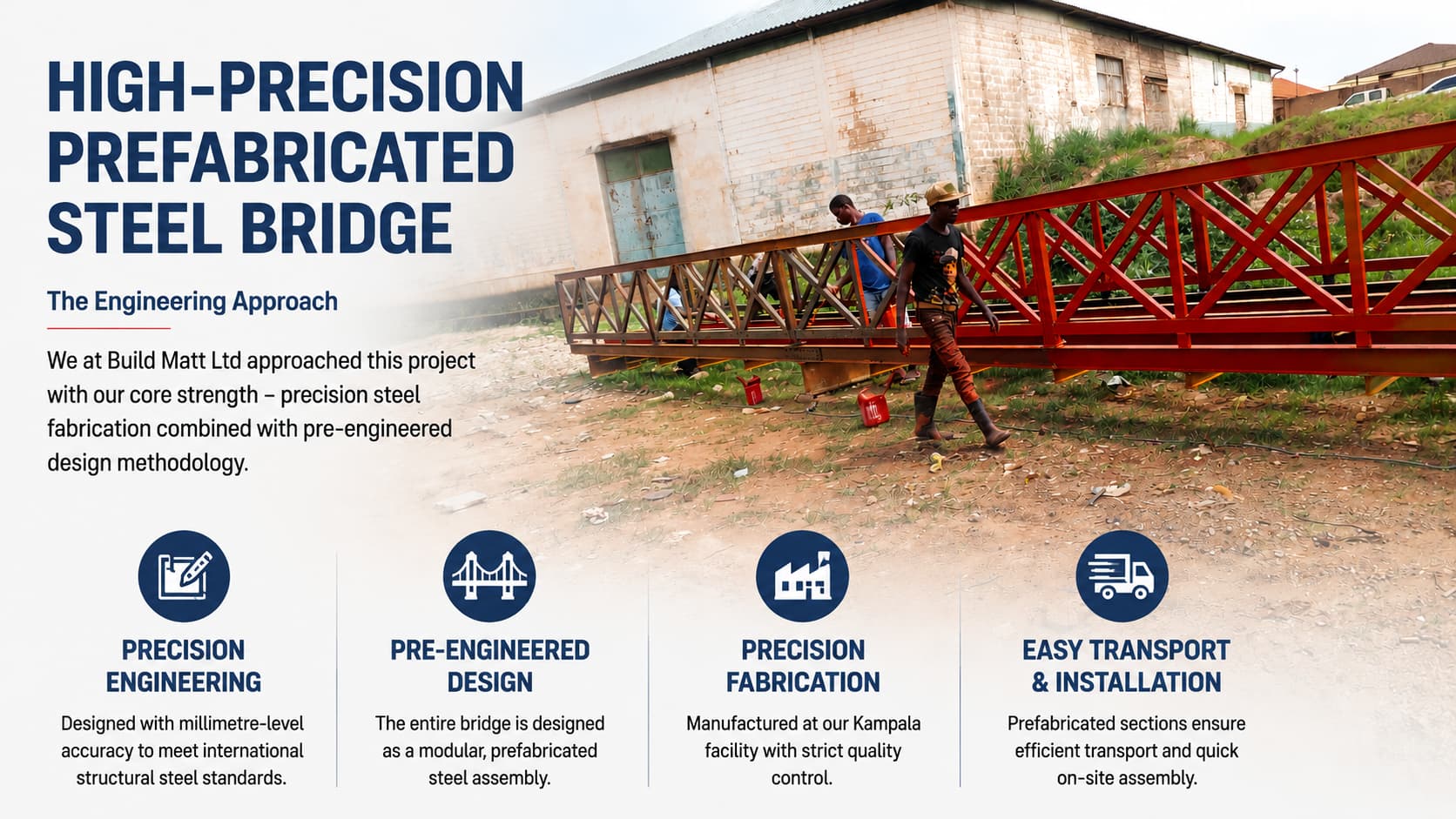
We at Build Matt Ltd approached this project with our core strength – precision steel fabrication combined with pre-engineered design methodology. Rather than attempting to build the bridge in situ, we designed the entire bridge structure as a modular, prefabricated steel assembly that could be manufactured with millimetre-level accuracy at our Kampala industrial facility and transported in sections to the site.
Our engineering team conducted a thorough site survey and structural load analysis, gathering data on the span distance, hill gradient, anchor point geology, expected pedestrian load, and local weather conditions. This data formed the foundation of a detailed engineering design that met international structural steel standards.
Our Other Product
Steel Trusses & Rafters FabricationHow We Built It: The Prefabrication Process
Step 1 – Site Survey & Engineering Design
Our team visited the site to measure exact span distances, hill profiles, and anchor point conditions. Detailed topographic data was used to create precise engineering drawings using CAD software. Load calculations were performed for static and dynamic pedestrian loads, wind loads, and safety factors.
Step 2 – Material Selection
We selected high-tensile structural steel sections – primary I-beams for main girders, hollow rectangular sections (RHS) for cross-bracing, and galvanised steel grating for the walking deck surface. All materials were sourced for their strength-to-weight ratio, corrosion resistance, and long-term durability in tropical conditions.
Step 3 – CNC Plasma Cutting & Precision Fabrication
Every steel component was cut using our CNC Plasma Cutting equipment to exact dimensions. Bolt holes, connection plates, and end bearings were all fabricated to precise tolerances. This ensured that every component would fit together perfectly on-site without requiring any on-site cutting or re-drilling.
Step 4 – Trial Assembly at Factory
Before dispatching to site, we conducted a complete trial assembly of the bridge structure at our Kampala facility. This critical quality step confirmed that all components aligned perfectly, all bolt connections matched, and the structural geometry was correct. Any minor deviations were corrected before the structure left the factory floor.
Step 5 – Surface Treatment & Anti-Corrosion Coating
All steel components were cleaned, blast-primed, and finished with a multi-layer anti-corrosion paint system suitable for tropical and humid environments. Critical joints and end bearings received additional corrosion protection to maximise service life.
Step 6 – Numbered & Marked for Easy Installation
Every component was clearly marked with assembly sequence numbers, orientation marks, and connection references. A detailed on-site assembly manual with diagrams was prepared so that the client’s local installation team could assemble the bridge in the correct sequence with confidence.
Step 7 – Transport & Delivery to Site
The bridge components were carefully loaded onto transport vehicles and delivered to the nearest road access point. From there, components were carried to the hill site using a combination of small vehicles and manual handling – made possible by the manageable size and weight of individual prefabricated sections.
Step 8 – On-Site Installation
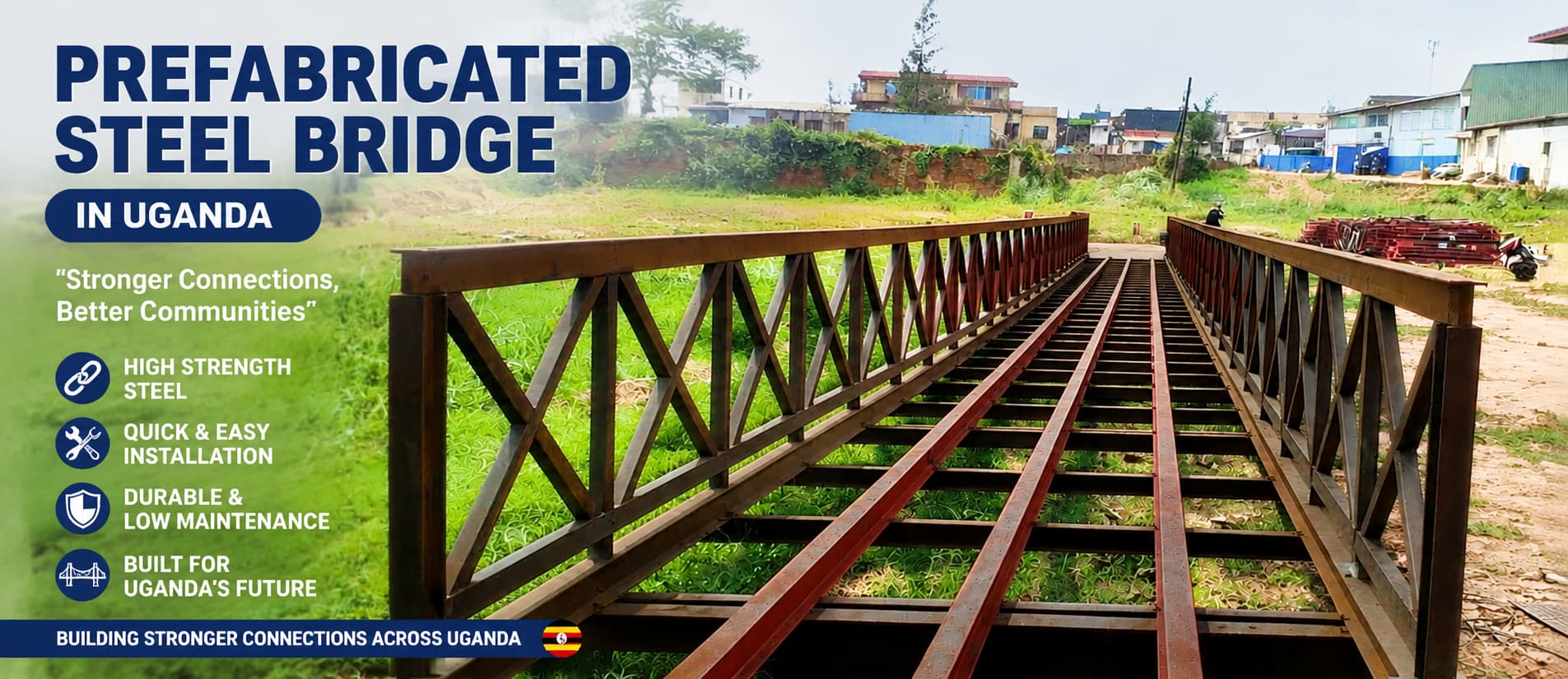
The client’s installation team, supported by our technical supervisor, assembled the bridge on-site following the marked assembly sequence. Anchor bolts were set into the hill rock faces using chemical anchoring techniques. The main girders were positioned and bolted, followed by cross-bracing, deck grating, and safety handrails. The entire on-site installation was completed in a matter of days – a fraction of the time required for conventional bridge construction.
Key Features of the Steel Bridge Structure
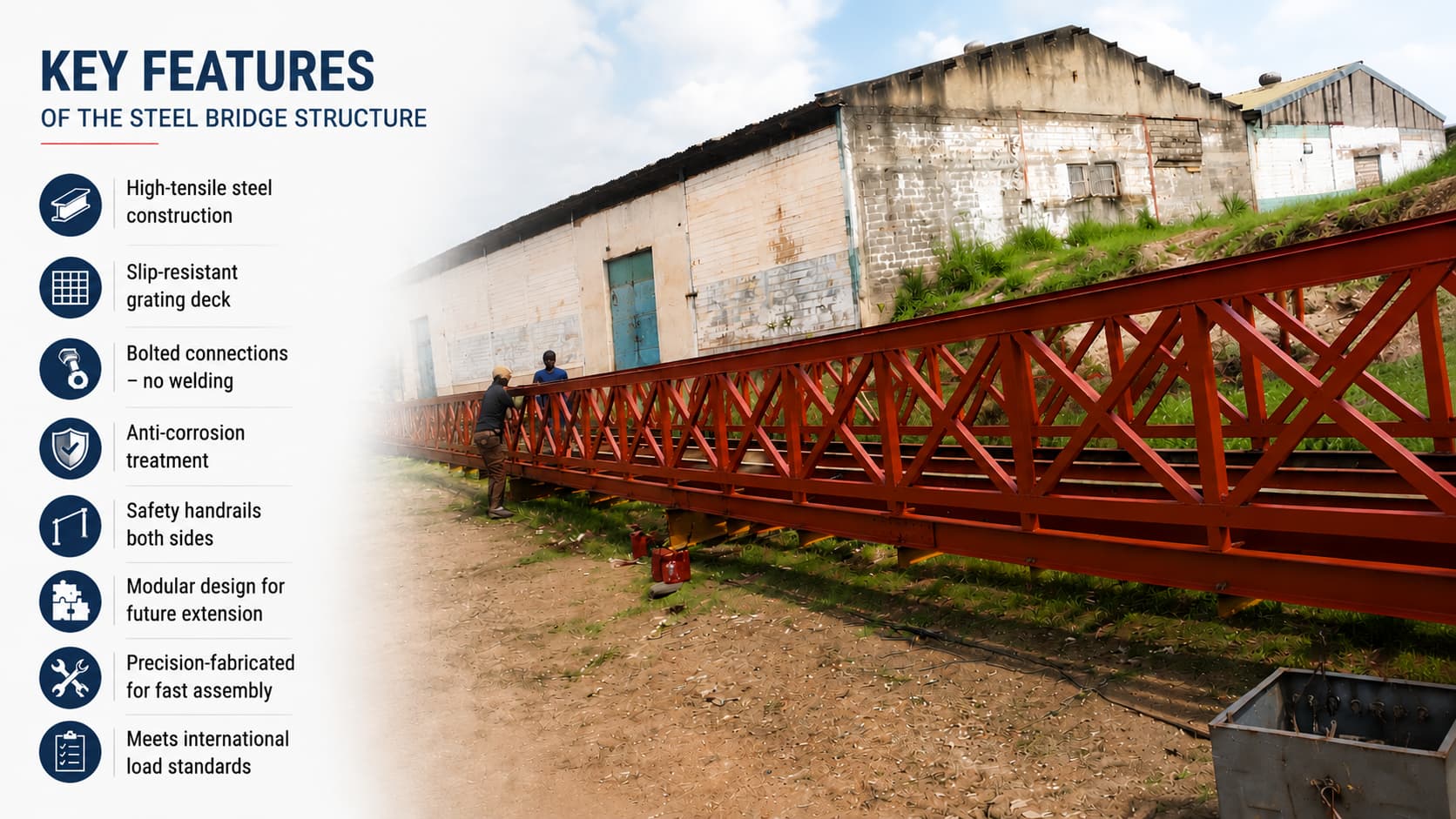
- High-tensile structural steel construction for maximum load capacity
- Galvanised steel grating deck for slip-resistant, low-maintenance walking surface
- Bolted connections throughout – no on-site welding required
- Anti-corrosion surface treatment for 20+ year service life in tropical climate
- Safety handrails on both sides for pedestrian protection
- Modular design allowing future extension or modification if required
- Precision-fabricated components for fast, accurate on-site assembly
- Designed to international pedestrian bridge load standards
Results & Outcomes
✅ Immediate Impact on Community Life
The installation of the prefabricated steel pedestrian bridge between the two hills transformed daily life for local residents almost overnight. What had previously been a multi-hour detour around the valley was now a short, safe crossing of just a few minutes. Children could reach school faster and more safely. Community members could access markets, healthcare, and social facilities on the neighbouring hill with ease.
✅ Dramatic Reduction in Travel Distance & Time
Local residents reported that the bridge reduced their travel time between the two hills by over 70%. Elderly residents and people with physical limitations – who had previously been largely cut off from the neighbouring community – could now cross independently and safely.
✅ Economic Benefits for the Community
Faster and easier access between the two hills opened up new economic opportunities. Small traders could move goods between the communities more efficiently. Local businesses saw increased foot traffic. Farmers could access wider markets without the burden of long detour routes. The bridge effectively enlarged the economic catchment area for both hill communities.
✅ Fast Installation with Minimal Disruption
Thanks to Build Matt’s prefabrication approach, the on-site installation was completed rapidly with a small local team using basic tools. There was no need for heavy machinery, no prolonged construction period, and minimal disruption to the local environment and community. The surrounding hillside terrain was preserved, and there was no requirement for large-scale earthworks.
✅ Structural Safety & Durability Confirmed
The completed bridge structure met all design load requirements and passed a thorough post-installation inspection. The precision fabrication ensured perfect alignment of all structural components, with no on-site modifications required. The anti-corrosion treatment and galvanised deck grating positioned the bridge for a service life exceeding 20 years with minimal maintenance.
✅ Community Pride & Social Connectivity
Beyond the practical benefits, the bridge became a symbol of progress and connectivity for the local community. It demonstrated that world-class steel engineering solutions could be delivered to remote rural locations in Uganda – proof that Build Matt’s prefabrication model can serve not just industrial and commercial clients, but also community-level infrastructure needs across East Africa.
Need More Information?
Email Us Today!
Why Prefabricated Steel Was the Right Choice
Factor | Prefabricated Steel (Build Matt) | Conventional Construction |
On-site construction time | Days | Months |
Heavy equipment required | No | Yes |
Remote location suitability | Excellent | Poor |
Quality control | Factory-controlled | Site-dependent |
Cost efficiency | High | Low |
Maintenance requirement | Minimal | Higher |
Structural accuracy | Millimetre precision | Variable |
Long-term durability | 20+ years | Variable |
Conclusion
This project stands as one of the most meaningful demonstrations of Build Matt Ltd’s prefabricated steel bridge construction capability in Uganda. By combining precision CNC fabrication, robust structural engineering, anti-corrosion treatment, and a thoughtful modular design, we delivered a steel pedestrian bridge that was safe, durable, affordable, and easy to install – even in one of Uganda’s most challenging remote terrains.
It is proof that prefabricated steel structures are not just for factories and warehouses – they are powerful, life-changing solutions for communities that need infrastructure fast, reliably, and within budget.
At Build Matt, we don’t just fabricate steel. We build connections – between hills, between communities, and between people.
Our Other Product
Steel Mezzanine FloorsReady to Build Your Next Steel Structure?
Build Matt Ltd – Uganda’s leading manufacturer of prefabricated steel structures, steel bridges, warehouses, and custom fabrications.
- 📍 Uganda: 1-3, Spring Road, 5th Street, Industrial Area, Kampala
- 📞 WhatsApp/Call: +256 753 592 635 | +256 759 403 077
- 📧 Email: info@buildmatt.net
- 🌐 Website: www.buildmatt.net
Frequently Asked Questions (FAQs) on Prefabricated Steel Bridge
A prefabricated steel bridge is a bridge structure that is fully manufactured and assembled in a factory environment to precise engineering specifications, then transported to the installation site in components for fast, accurate assembly. It eliminates the need for extensive on-site construction, heavy equipment, and prolonged installation timelines.
Unlike conventional bridge construction that can take months, a prefabricated steel bridge from Build Matt can typically be installed on-site in a matter of days, depending on the span length and site conditions. The bulk of the work happens in our factory, where quality is controlled and speed is maximised.
Yes - in fact, prefabricated steel bridges are ideally suited for remote and difficult terrain locations. Because components are manufactured off-site and transported in manageable sections, there is no need for heavy on-site equipment. Build Matt's modular designs are specifically engineered for easy manual assembly by small local teams.
Build Matt's steel bridges are treated with a multi-layer anti-corrosion coating system and use galvanised components where appropriate, providing a service life of 20 years or more even in Uganda's humid, high-rainfall tropical climate. The steel grades selected are chosen for their performance in tropical and sub-tropical environments.
Each bridge is individually engineered based on the specific span, location, and expected use. Pedestrian bridges are designed to international standards for pedestrian live loads, crowd loading, wind loading, and safety factors. Build Matt's engineers provide full structural calculations for every project.
Yes, significantly. Prefabricated steel bridges reduce on-site labour requirements, eliminate the need for heavy construction equipment, shorten installation timelines, and minimise material wastage. For remote locations where logistics costs are high, the cost advantage of prefabrication is even more pronounced.
Absolutely. Build Matt serves clients across Uganda, South Sudan, Rwanda, Burundi, the Democratic Republic of Congo, and Kenya. Our prefabricated structures are designed for efficient transport across the East African region.
Yes. Build Matt provides complete engineering drawings, component assembly manuals, and on-site technical supervision support to ensure correct and safe installation of every prefabricated steel structure we supply.
Build Matt fabricates a comprehensive range of steel structures including warehouses, factory sheds, cold storage facilities, fuel station canopies, mezzanine floors, steel trusses, container offices, steel furniture, and more. Visit www.buildmatt.net for the full product range.
Simply contact us via WhatsApp, phone, or email with your project details - including the span length, location, expected use, and any site access constraints. Our engineering team will assess your requirements and provide a detailed quotation.

Founder & CEO
Mukesh Patel is the Founder & CEO of Build Matt ltd, specializing in Pre-Engineered Buildings (PEB) and general steel fabrication. With advanced technology, modern machinery, and a skilled workforce, he delivers efficient and high-quality solutions across East and Central Africa, including Uganda, Kenya, Tanzania, Congo, South Sudan, Rwanda, and Burundi.
Recent Blogs
- Metal Stairs and Railings for Industrial Facilities: Safety, Design and Installation Considerations
- Free Standing Mezzanines vs Building Supported Mezzanines: Which Solution Is Right for Your Warehouse?
- Steel Industrial Rack vs Commercial Rack: Understanding the Key Differences for Businesses
- How to Design a Car Parking Structure for Multiple Vehicles and Maximum Space Efficiency
- How to Choose the Right Shade Structure for Balconies, Windows and Outdoor Spaces