

Read Our Article
What are the Benefits of Using Steel Platforms and Walkways in Industrial Facilities?Stainless Steel vs Galvanized Steel Cable Trays: Which One Should You Choose?
August 4, 2026
Share At:




Listening Article
AI Summary
Choosing between stainless steel and galvanized steel cable trays depends on corrosion exposure, moisture, chemical contact and humidity, cable load, tray design, durability needs, maintenance capacity, installation location and project budget. Stainless steel suits harsh, chemically exposed or coastal environments, while galvanized steel is a practical, economical choice for standard indoor and outdoor installations. Build Matt supplies, fabricates and supports the installation of both cable tray materials for commercial and industrial projects across Uganda.
Selecting the Right Cable Tray Material for Your Uganda Project
Cable tray selection affects the safety, cost and long term reliability of any electrical installation. Two material options dominate the Uganda market: stainless steel cable tray systems and galvanized steel cable tray systems.
Each material performs differently depending on the environment, cable load and installation method involved. A cable tray Uganda businesses install in a coastal warehouse faces very different conditions from one installed in a dry, climate controlled office building.
Build Matt works with electrical contractors, engineers and facility managers across Kampala and other parts of Uganda to help match the correct cable tray material, design and size to each project. This article explains the practical differences between stainless steel and galvanized steel cable trays and how to choose the right cable management system for your specific application.
Quick Response Guaranteed
Email Us Now!
What Are Stainless Steel and Galvanized Steel Cable Trays?
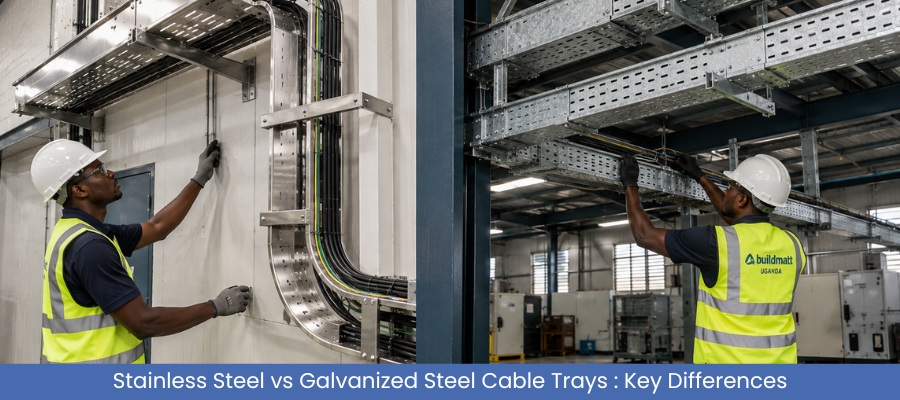
Stainless steel and galvanized steel cable trays are structural systems used to support, organize and protect electrical cables along a defined route.
Both start as steel, but the corrosion protection method differs.
Stainless Steel Cable Tray Construction
A stainless steel cable tray is made from steel alloyed with chromium and other elements. This creates a passive oxide layer on the surface that resists corrosion from within the material itself, rather than relying on an applied coating.
Galvanized Steel Cable Tray Construction
A galvanized steel cable tray, also written as galvanised steel cable tray, is carbon steel coated with zinc, typically through hot dip galvanizing. The zinc layer protects the underlying steel by acting as a sacrificial barrier against moisture and oxidation.
Cable tray galvanized steel construction is widely used because it combines solid mechanical strength with practical, cost effective corrosion protection for many indoor and outdoor settings.
Both materials are available in the same tray configurations, including ladder, perforated, wire mesh and basket designs. Build Matt manufactures and supplies both stainless steel and galvanized steel options, allowing project teams to compare specifications before choosing a system for their site.
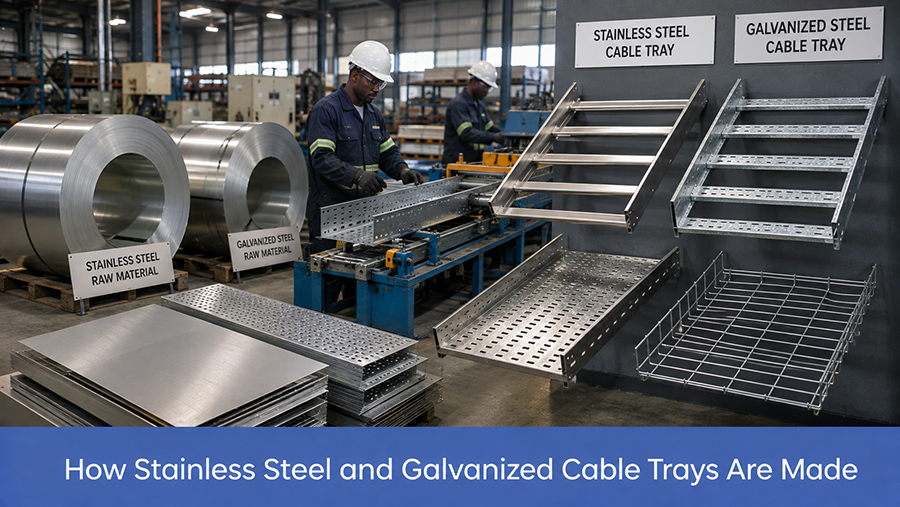
Stainless Steel vs Galvanized Steel: Key Differences at a Glance
The clearest way to compare a stainless steel cable tray and a galvanized steel cable tray is across the factors that matter most on site.
| Factor | Stainless Steel Cable Tray | Galvanized Steel Cable Tray |
|---|---|---|
| Corrosion resistance | Built into the material, depending on grade selected | Depends on zinc coating quality and exposure conditions |
| Durability | Performs well under prolonged moisture and chemical exposure | Performs reliably in standard indoor and many outdoor settings |
| Strength | Comparable strength to galvanized steel at equal thickness | Comparable strength to stainless steel at equal thickness |
| Maintenance | Generally requires less ongoing corrosion related maintenance | May need periodic coating inspection in humid or exposed areas |
| Typical environment | Corrosive, chemically exposed or coastal settings | General industrial, commercial and residential settings |
| Cost consideration | Higher upfront material investment | More economical for standard applications |
No single material is universally correct. Build Matt reviews environmental and budget factors with clients before recommending a stainless steel or galvanized steel specification.
How Corrosion Resistance Affects Cable Tray Selection?
Corrosion resistance often determines how long a cable tray performs safely before it needs replacement.
Actual performance depends on several combined factors rather than material choice alone:
- The specific material grade selected
- The quality and thickness of any protective coating
- The surrounding environment and climate
- The level of chemical exposure
- Ambient moisture and humidity
- Proximity to salt air or water
- How consistently the installation is maintained
Environments Where Corrosion Resistance Matters Most
- Facilities with high humidity or frequent washdown, such as food and beverage plants
- Sites exposed to chemicals, acids, alkalis or industrial fumes
- Coastal or high salinity locations
- Outdoor installations exposed to rain and temperature change
- Water treatment plants and facilities handling corrosive liquids or gases
In these conditions, a stainless steel perforated cable tray is commonly specified. The ventilated design reduces trapped moisture, while the material resists the surrounding chemical or humid conditions.
Build Matt advises clients on matching tray grade and design to the corrosion risks present at their specific site rather than applying one standard specification everywhere.
Choosing the Right Cable Tray Design for Electrical Installations
Material and design decisions work together. Once the right material is identified for the environment, the next step is selecting the correct electrical cable tray types for cable support, ventilation and access.
Common cable tray types include:
- Ladder trays, using side rails and rungs, suited to heavier cable loads needing strong ventilation
- Perforated trays, offering a solid base with ventilation holes for consistent cable support
- Wire and basket trays, using open construction suited to lighter loads and flexible routing
- Wire mesh trays, providing fine continuous support suited to data and communication cables
- Enclosed cable ducts and metal cable trunks, fully covering cables for extra protection
Each design is available in both stainless steel and galvanized steel. Build Matt supplies the full range of cable tray types in both materials and helps contractors confirm the correct design for specific cable loads and routing requirements before manufacturing begins.
Our Other Product
Prefabricated Showrooms & Commercial Building StructuresPerforated Cable Tray vs Ladder Tray: Which Design Works Better?
Neither design is universally better. The right choice depends on the balance a project needs between cable support, ventilation, accessibility and load.
When a Perforated Cable Tray Works Best
A perforated cable tray provides a continuous, part solid base with regularly spaced holes. It offers strong physical support along the full cable length while still allowing airflow and drainage.
This design suits projects with:
- Smaller or more delicate cables needing consistent support
- Tighter bends or frequent changes in direction
- Moderate ventilation needs
When a Ladder Tray Works Best
A ladder tray uses side rails connected by evenly spaced rungs. The open structure maximizes airflow, supporting heat dissipation for higher current cables, and makes it easier to access cables for future additions.
This design suits projects with:
- Higher power cables generating more heat
- Long, straight cable runs
- Frequent need for future cable access
Build Matt manufactures both perforated cable tray and ladder tray options in stainless steel and galvanized steel and can advise on the configuration best suited to a specific cable schedule.
Speak with an Expert
 Call Us Now!
Wire and Basket Cable Trays: Stainless Steel vs Galvanized Options
Wire and basket cable trays, sometimes called a steel wire cable tray or cable basket, use an open lattice construction instead of a solid or perforated base.
This open wire design keeps the tray lightweight and maximizes airflow, which simplifies installation, particularly for lighter cable loads or retrofit projects with limited working space.
Because the structure is open, a wire tray gives clear visibility of the cables inside. Maintenance staff can inspect cable condition, identify individual cables and carry out additions or repairs without removing sections of the tray. This is one of the main practical advantages of a basket for cables.
Stainless Steel Basket Tray Applications
A stainless steel basket tray, sometimes specified as a stainless steel wire basket tray, suits environments needing the open design combined with resistance to moisture, chemicals or hygiene sensitive conditions, such as food processing or laboratory settings.
Galvanized Steel Wire Tray Applications
A galvanized steel wire tray delivers the same lightweight, open functionality for general commercial and industrial settings where extreme corrosion resistance is not the primary requirement.
Build Matt supplies wire and cable basket trays in both materials, with sizing and mesh spacing adjusted to suit the cable types and quantities specified by the client.
Wire Mesh Cable Tray for Industrial and Commercial Applications
A wire mesh cable tray uses a fine, continuous mesh construction rather than the wider spacing found in typical wire or basket trays.
This makes a mesh wire cable tray particularly well suited to smaller diameter cables, structured data cabling and communication lines that need consistent, close support while still benefiting from an open, ventilated structure.
When Mesh Construction Is Preferable
Mesh designs are generally preferable to solid or perforated trays for:
- Data centres, server rooms and IT infrastructure needing airflow and cable bend radius control
- Office and commercial buildings with extensive structured cabling
- Areas requiring frequent cable moves or additions, since cables can be lifted in and out easily
- Exposed ceiling routes where a lightweight, low profile tray is preferred
A mesh wire tray also tends to shed dust more effectively than a fully solid tray, which helps in environments where accumulated debris could affect cable performance.
Build Matt produces wire mesh cable tray systems for both structured data cabling projects and general purpose commercial installations, with sizing matched to specific cable bundle diameters.
Cable Tray Installation: Ceiling, Hanging and Floor-Mounted Applications
Installation position affects both the mechanical support required and, in many cases, the material best suited to the location.
Cable Tray for Ceiling Installation
A cable tray for ceiling installation is mounted directly to structural elements overhead, keeping cable routes clear of floor level activity. This is common in warehouses, production facilities and commercial buildings.
Hanging Cable Tray Systems
A hanging cable tray is suspended using threaded rod, trapeze supports or bracket systems rather than being fixed directly to a surface. This offers flexibility in routing around existing structural features or other services.
Floor Cable Tray Systems
A floor cable tray is installed within trenches, raised floor systems or along wall bases. This suits facilities such as data centres with raised access floors or industrial areas with overhead crane operations where overhead routing is not practical.
Outdoor or exposed overhead installations, areas near roof penetrations, and washdown locations tend to benefit from stainless steel. Indoor, sheltered installations are often well served by galvanized steel.
Build Matt supports clients with installation guidance and, where needed, coordinates with contractors on support spacing, bracketry and material selection for installing cable tray systems in ceiling, hanging and floor mounted applications.
Cable Racking, Cable Tracks and Cable Management Systems
Individual cable trays are rarely used alone. Most sites use a broader cable management system that includes cable racking, cable tracks, brackets, couplers, covers and accessories.
Cable racking generally refers to the structural framework, including uprights and support arms, that holds one or more cable trays or cable tracks in position, particularly for multiple parallel cable runs.
Cable tracks and cable manager tray systems guide cables along a defined route while keeping different cable types, such as power, control and data, appropriately separated.
A well planned cable management tray system reduces the risk of cable damage, simplifies maintenance and makes circuits easier to trace, which matters most in facilities with complex electrical layouts.
Wire management tray components, including dividers, covers and junction pieces, allow a system to adapt as a facility’s cabling needs grow.
Build Matt supplies complete cable management systems Uganda businesses can rely on, combining tray, racking, tracks and accessories from a single source, which simplifies procurement and helps ensure compatibility across an installation.
We are Available on Chat, Call, Email!
Email!
Stainless Steel Cable Duct and Metal Cable Trunk: When Should You Use Them?
Open cable trays are not always the right solution. Where cables need full physical enclosure, a cable duct or metal cable trunk is generally more appropriate.
Cable Duct Stainless Steel Applications
A cable duct stainless steel design fully encloses cables within a rigid housing. It protects against dust, moisture, physical impact and, in many settings, unauthorized access. This suits environments needing shielding from washdown, chemical splash or particulate contamination.
Metal Cable Trunk Applications
A cable trunk, often manufactured as a metal cable trunk, similarly provides an enclosed channel for cables. It is commonly used in commercial buildings and office fit outs where a neat, fully covered cable route is required.
Enclosed ducts and trunks offer greater physical protection than open trays but generally reduce airflow, which is a factor to weigh for higher current or heat generating circuits.
Build Matt manufactures stainless steel cable duct and metal cable trunk options alongside its open tray range, allowing clients to specify enclosed protection where needed and open systems elsewhere on the same project.
Cable Tray Sizing: How to Select the Right Width, Depth and Load Capacity?
Correct cable tray sizing starts with a clear count of the cables the tray needs to carry today, plus a realistic allowance for future additions.
Key factors that determine appropriate sizing include:
- The total number and diameter of cables to be installed initially
- The bend radius requirements of the largest or most sensitive cables
- Anticipated future cable capacity, since undersized trays are costly to expand later
- The combined weight of the cables and the tray, which sets required support spacing
- Required clearance for maintenance access
- Separation needs between different cable types, such as power and data
Trays sized only for current cable counts often need replacement or supplementing sooner than expected as facilities expand. Allowing reasonable spare capacity at the design stage is generally more cost effective than adding tray runs later.
Build Matt works with clients during specification to review current cable schedules alongside anticipated future needs, helping ensure the tray width, depth and load rating selected will continue to serve the facility as it grows.
Stainless Steel Cable Tray Price vs Galvanized Steel Cable Tray Cost
There is no single fixed answer to how stainless steel cable tray price compares with cable tray galvanized steel cost. Pricing for both materials depends on project specific variables rather than a flat rate per length.
Factors that influence pricing include:
- Material grade selected
- Steel thickness and gauge
- Tray dimensions, including width, depth and length
- Design and configuration, such as ladder, perforated, wire, basket or mesh
- Surface finish and any additional coating or treatment
- Accessories required, including couplers, brackets, covers and bends
- Order quantity
- Installation requirements, including site access and labour considerations
- Specific project specifications, including custom fabrication
Because these variables differ from project to project, an accurate stainless steel cable tray price or galvanized steel cable tray price can only be confirmed once the specific requirements of an installation are known.
Build Matt prepares detailed quotations based on actual project drawings, cable schedules and site conditions, giving clients in Uganda a realistic cost picture rather than a generic estimate.
Which Cable Tray Material Is Best for Indoor, Outdoor and Harsh Industrial Environments?
Material suitability depends primarily on the environment the tray will operate in over its service life.
Indoor and Standard Outdoor Environments
For general indoor commercial and light industrial settings with stable temperature and low chemical exposure, a galvanised steel cable tray typically provides reliable, cost effective performance.
For outdoor installations exposed to rain and temperature variation, galvanized steel remains a practical choice, provided the coating is appropriate to the expected exposure level.
Harsh and Corrosive Environments
For harsh industrial environments, including chemical processing, high humidity, frequent washdown or airborne contaminants, a heavy duty stainless steel cable tray is generally the stronger long term option, since corrosion resistance is inherent to the material rather than dependent on a coating layer.
Coastal or high salinity locations, food and beverage production areas, and water or wastewater treatment facilities often fall into this category, where a stainless steel perforated cable tray is frequently specified.
Application based guidance:
- Standard offices, warehouses and light commercial buildings: galvanized steel is generally suitable
- Outdoor overhead runs with normal weather exposure: galvanized steel is generally suitable, subject to coating specification
- Chemical processing, pharmaceutical or food production facilities: stainless steel is generally preferred
- Coastal, marine or high salinity sites: stainless steel is generally preferred
- Water treatment or high moisture industrial areas: stainless steel is generally preferred
Build Matt reviews environmental exposure details with clients before recommending a material, ensuring the specification reflects the actual demands of the location.
How to Choose the Best Cable Tray for Your Application
Choosing the best cable tray comes down to working through a small number of practical questions in sequence.
Step One: Assess the Environment
Indoor, sheltered locations generally allow more flexibility between galvanized steel and stainless steel. Outdoor, humid, chemically exposed or coastal conditions point more strongly toward stainless steel or a well specified galvanized coating suited to that exposure.
Step Two: Consider Cable Type and Load
Heavier power cables often suit ladder or perforated designs with strong ventilation. Data, communication and smaller cables are frequently well served by wire mesh or wire tray systems. Where cables need full physical protection, a cable duct or metal cable trunk may be the more appropriate cable management tray option.
Step Three: Assess Installation Location
Ceiling, hanging and floor mounted applications each carry different structural and access considerations. The mounting method should be confirmed early since it affects both material and design selection.
Step Four: Factor in Corrosion Exposure and Budget
A higher initial investment in stainless steel can reduce long term maintenance and replacement needs in demanding environments. Galvanized steel offers strong value where conditions are less severe.
Reviewing the electrical cable tray types available, alongside anticipated future cable capacity, helps avoid under specifying a system that will need early expansion.
Build Matt supports businesses through each of these decision points, from initial material and design selection through to sizing, customization, supply and installation support, helping ensure the cable tray system specified is matched accurately to actual operating conditions.
Cable Tray Supplier Uganda: Build Matt
Build Matt is a cable tray supplier Uganda businesses turn to for stainless steel and galvanized steel cable trays, cable racking, cable tracks, cable ducts and metal cable trunks across ladder, perforated, wire, basket and wire mesh designs. The company supports clients from material and design selection through sizing, custom fabrication, supply and installation planning, helping ensure each cable management system matches the actual environmental conditions and cable loads on site. Businesses across Kampala and other parts of Uganda work with Build Matt for both single site and larger, multi site cable tray projects.
Stainless Steel vs Galvanized Steel Cable Tray: Final Selection Guide
Choosing between a stainless steel cable tray and a galvanized steel cable tray comes down to matching the material to the environment, cable load and budget of a specific project. Stainless steel offers corrosion resistance built into the material, suited to harsh, chemically exposed or coastal conditions, while galvanized steel offers reliable, economical protection for standard indoor and outdoor installations. Tray design, sizing, installation location and future cable capacity also shape which cable management system performs best over time. Build Matt supports Uganda based businesses through this decision process, from material and design selection to sizing, fabrication, supply and installation support.
FAQs on Stainless Steel vs Galvanized Steel Cable Trays
A stainless steel cable tray resists corrosion through the material itself, while a galvanized steel cable tray relies on a zinc coating applied to carbon steel. Stainless steel generally suits harsher or corrosive environments, while galvanized steel is a practical option for standard indoor and outdoor installations.
Both materials can be used outdoors. Galvanized steel is commonly used where weather exposure is moderate, provided the coating suits the environment. Stainless steel is generally preferred for coastal, high salinity or heavily corrosive outdoor conditions.
Galvanized steel cable tray combines solid mechanical strength with practical corrosion protection at a generally more economical cost, making it suitable for many standard commercial and industrial installations across Uganda.
A stainless steel perforated cable tray is typically used where corrosion resistance needs to be inherent to the material, such as in chemically exposed, humid, coastal or hygiene sensitive environments like food processing facilities.
Perforated trays suit smaller or more delicate cables needing continuous support, while ladder trays suit heavier cable loads that benefit from stronger ventilation and easier future access.
A wire mesh cable tray is commonly used for data, communication and structured cabling where consistent support, airflow and flexibility for future cable changes are required.
Cable tray capacity depends on the tray width, depth and load rating, as well as the diameter and weight of the cables involved. Build Matt reviews cable schedules to help determine appropriate sizing for each project.
Cable tray can be installed at ceiling level, suspended as a hanging cable tray, or positioned at floor level within trenches or raised floor systems, depending on the facility layout and access requirements.
Pricing for both materials depends on factors such as material grade, thickness, tray dimensions, design, finish, accessories and installation requirements. Build Matt provides project specific quotations based on actual specifications.
Wire mesh cable tray and wire basket cable tray designs are commonly used in data centres due to their airflow, cable visibility and ease of access for future cable additions.
Build Matt supports businesses in Uganda with cable tray material selection, sizing, customization, fabrication and installation planning for commercial and industrial cable management projects.
Cable tray sizing depends on the number and diameter of cables, required bend radius, anticipated future cable capacity, combined weight load and necessary maintenance clearance.

Founder & CEO
Mukesh Patel is the Founder & CEO of Build Matt ltd, specializing in Pre-Engineered Buildings (PEB) and general steel fabrication. With advanced technology, modern machinery, and a skilled workforce, he delivers efficient and high-quality solutions across East and Central Africa, including Uganda, Kenya, Tanzania, Congo, South Sudan, Rwanda, and Burundi.
Recent Blogs
- Metal Stairs and Railings for Industrial Facilities: Safety, Design and Installation Considerations
- Free Standing Mezzanines vs Building Supported Mezzanines: Which Solution Is Right for Your Warehouse?
- Steel Industrial Rack vs Commercial Rack: Understanding the Key Differences for Businesses
- How to Design a Car Parking Structure for Multiple Vehicles and Maximum Space Efficiency
- How to Choose the Right Shade Structure for Balconies, Windows and Outdoor Spaces