
Read Our Article
Steel Railings & Balustrades for Uganda CitiesHow to Choose the Right Railing Height and Baluster Spacing for Indoor Staircases
May 5, 2026
Share At:




Listening Article
AI Summary
Getting railing height and baluster spacing right on indoor staircases is not just an aesthetic decision—it is a fundamental safety and legal compliance requirement for every building in Uganda. This guide by Build Matt Ltd., Uganda’s leading steel railings and steel staircases manufacturer, explains the applicable standards, practical height and spacing rules, material options (mild steel, stainless steel, and combined systems), and design considerations for residential, commercial, and institutional staircases across Kampala and the wider East African region. Whether you are an architect specifying a new apartment building, a contractor fitting a home staircase, or a developer reviewing building permit documents, this guide provides the authoritative reference you need.
Why Railing Height and Baluster Spacing Are Safety-Critical Decisions
A staircase railing is among the most touched and most safety-critical elements in any building. Every day, people lean against railings for balance, grip handrails in the dark, and—critically—children test the gaps between balusters. A railing that is too low fails to catch a falling adult. A baluster gap that is too wide allows a child’s head to pass through and become entrapped—a leading cause of serious staircase injury in buildings worldwide.
Build Matt Ltd. has fabricated and installed steel staircase railings and steel balustrades for residential homes, apartments, schools, hospitals, offices, banks, and government buildings across Uganda since 2001. In that time, the company has seen the consequences of under-specified railings and provided remediation for many structures where original railings did not meet minimum safety requirements. This guide consolidates the design and compliance knowledge that Build Matt’s engineering team applies on every staircase railing project.
Applicable Standards for Staircase Railings in Uganda
Uganda’s building regulatory environment references British Standards (BS) and international codes as the technical basis for staircase and railing design. The primary references are:
- BS 6180: Barriers in and around buildings — the core standard defining height, load capacity, and geometric requirements for railings, balustrades, and barriers in UK and East African practice.
- BS 5395: Stairs, ladders, and walkways — specifying staircase geometry including riser height, going (tread depth), and their relationship to railing requirements.
- Uganda Building Control Act and local authority regulations administered by KCCA (Kampala Capital City Authority) and district local governments for structures outside Kampala.
- ISO 21542: Building accessibility — providing guidance on handrail dimensions and continuity requirements for inclusive design.
Build Matt’s engineering team works with these standards on every staircase railing project, providing structural calculations and compliance documentation for building permit submissions.
Call Now for Instant Assistance!
 Call Now
Railing Height: The Correct Dimensions for Different Building Types
Residential Buildings — Homes and Apartments
For residential staircases in Uganda’s homes, duplexes, and apartment buildings, the minimum recommended guardrail (balustrade) height is 900 mm measured vertically from the pitch line of the stair — the imaginary line connecting the nosings (front edges) of each stair tread. The handrail — the grippable top element — should be positioned between 840 mm and 1,000 mm above the pitch line.
In Uganda’s growing apartment sector — particularly in Kampala areas like Ntinda, Naguru, Bugolobi, Kiwatule, and Muyenga — Build Matt recommends specifying handrail height at 950 mm to 1,000 mm above the pitch line for apartment buildings. The additional height provides greater protection and is consistent with the international practice increasingly expected by tenants and property valuers in Uganda’s maturing residential market.
Commercial Buildings — Offices, Banks, Retail, and Hotels
For commercial buildings, the minimum guardrail height is 1,100 mm above finished floor level (AFL) at landings, mezzanine edges, and gallery openings. On staircase flights within commercial buildings, the minimum height is 900 mm above the pitch line, though 1,000 mm is standard practice and strongly recommended by Build Matt for commercial staircases serving large numbers of people.
Stainless steel staircase railings (grade 304 or 316) are the preferred material for commercial buildings in Uganda due to their corrosion resistance, low maintenance, and premium visual quality. Build Matt’s steel railings manufacturers division fabricates and installs stainless steel balustrades for Uganda’s leading banks, hotels, office towers, and shopping developments.
Public and Institutional Buildings — Schools, Hospitals, Government
For Uganda’s public buildings — schools, hospitals, universities, courts, and government offices — the minimum guardrail height is 1,100 mm on all exposed edges. Staircase handrail height should be 900 mm above the pitch line, and a second lower handrail at 650 mm to 750 mm is recommended for inclusive access by children, wheelchair users, and people of short stature.
In schools and paediatric hospital wards, special attention to baluster design is essential: no horizontal members below 900 mm that could serve as climbing footholds, and baluster spacing strictly not exceeding 100 mm.
Our Other Product
Water & Storage Tanks, Steel Silos & Hoppers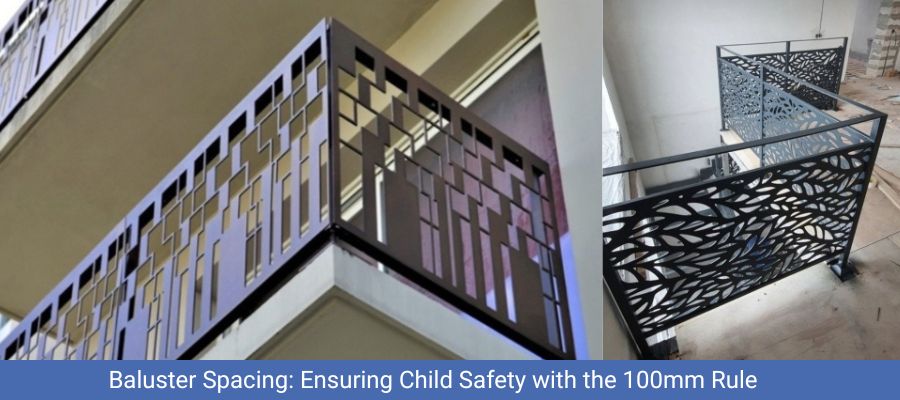
Baluster Spacing: The Critical Child Safety Dimension
Baluster spacing — the clear gap between adjacent vertical members of the railing infill — is the single most safety-critical geometric dimension in staircase railing design. The universal requirement across all major international building codes is a maximum clear gap of 100 mm between balusters.
The 100 mm limit is derived from anthropometric research: a sphere of 100 mm diameter represents approximately the size of a small child’s head. If the baluster gap is 100 mm or less, a child cannot pass their head through the gap. If the gap exceeds 100 mm, head entrapment and strangulation risk increases significantly.
Why 100 mm — and Not More
Build Matt’s engineering team encounters a common field problem: contractors who space balusters by eye rather than measurement, or who space them based on the overall look of the railing rather than the child safety dimension. In practice, a railing that looks ‘not too open’ to an adult observer can easily have gaps of 120 mm to 150 mm — well above the safe limit. Build Matt fabricates all balusters to exact spacing drawings, and installers check spacing with a 100 mm gauge template before final fixing.
Spacing for Different Baluster Profiles
- Round tube balusters (most common in Uganda’s residential market): Measure the clear gap between the outer surfaces of adjacent tubes. With 25 mm diameter tubes at 100 mm clear spacing, the centre-to-centre spacing is 125 mm.
- Square hollow section (SHS) balusters: Measure the clear gap between the flat faces of adjacent square sections. With 20 mm SHS balusters at 100 mm clear spacing, the centre-to-centre spacing is 120 mm.
- Flat bar balusters: Measure clear gap between the narrow edges of adjacent flat bars.
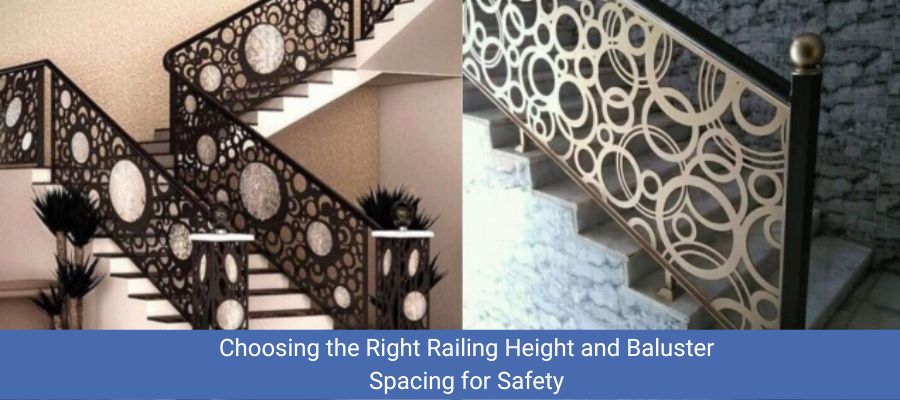
- Decorative laser-cut panels: The maximum opening in any decorative panel infill must not exceed 100 mm in its smallest dimension — both horizontally and vertically — to prevent head entrapment.
No Horizontal Members Below 900 mm: The Climbing Rule
An equally important but often overlooked rule in staircase railing design is the prohibition of horizontal members — rails, bars, or decorative elements — below 900 mm height in any building accessible to children. Horizontal members create a ladder-like structure that invites children to climb over the railing, dramatically increasing fall risk.
This rule means that:
- The design style of horizontal parallel bar railings — popular in contemporary architecture — must not be used below 900 mm in any building where children are present.
- Where horizontal bar railings are used, only the top rail (handrail) should be at or above 900 mm. Below the handrail, the infill should consist of vertical balusters only.
- Decorative scrollwork and infill patterns must not include any horizontal elements below 900 mm height in school, nursery, hospital, or family residential applications.
Handrail Dimensions: Grip Ergonomics and Code Requirements
The handrail is the grippable element at the top of the staircase railing, and its cross-section determines whether users can maintain a firm, comfortable grip — particularly during an emergency descent. For full-grip handrails (where the fingers can wrap around the rail), the recommended dimensions are:
- Round handrail: Outer diameter 32 mm to 50 mm. The most ergonomically effective profile for a power grip.
- Oval or elliptical handrail: Major axis 50 mm maximum, minor axis 32 mm minimum.
- Rectangular handrail (flat top rail): Maximum width 50 mm, minimum depth 35 mm. Less comfortable for sustained grip than round profiles.
Build Matt fabricates handrails in round stainless steel tube (the premium commercial option), round mild steel tube (residential and budget-commercial), and rectangular hollow section (for contemporary and architectural designs). All handrail ends are returned to the wall or to a post to prevent clothing snagging — a requirement under BS 6180 for accessible buildings.
Handrail Continuity and Extensions
For staircases in public buildings and accessibility-compliant commercial buildings in Uganda, handrails must be continuous along the full length of each flight and should extend beyond the top and bottom risers:
- At the top of a stair flight: Handrail extends horizontally for a minimum of 300 mm beyond the last riser nosing.
- At the bottom of a stair flight: Handrail extends along the stair slope for one full tread depth (approximately 250–300 mm) beyond the bottom riser nosing.
These extensions allow users to establish their grip and balance before stepping onto the first or last tread — an important safety feature for elderly users and people with mobility limitations.
Our Other Product
Container Offices & Homes - Modern Modular SpacesMaterial Choices for Indoor Staircase Railings in Uganda
Mild Steel with Hot-Dip Galvanizing and Powder Coating
The most widely used material for indoor staircase railings in Uganda’s residential and medium-budget commercial market. Hot-dip galvanized mild steel balusters and posts with powder coating in the client’s choice of colour provide a durable, cost-effective, and visually attractive railing system. Build Matt recommends 60–80 microns of polyester powder coat for interior applications, with epoxy powder coat for exterior or moist environments.
Stainless Steel (Grade 304 or 316)
The premium choice for commercial buildings, hotels, banks, hospitals, and upscale residential developments. Stainless steel (grade 304 for dry interior environments, grade 316 for moist or external applications) requires no surface coating and provides a bright brushed or mirror-polished finish with exceptional durability. Build Matt’s steel railings manufacturers division installs stainless steel staircases for Uganda’s leading commercial and institutional clients.
We are Fast in Response
Contact Now!
Why Choose Build Matt Ltd. for Staircase Railings in Uganda?
Build Matt Ltd. is Uganda’s leading steel railings manufacturer, steel balustrades fabricator, and staircase railing installer. Our in-house engineering team prepares structural design calculations for every staircase railing project, our CNC plasma cutting workshop fabricates components to precise drawings, and our installation team applies a 100 mm gauge check on every baluster installation. Contact Build Matt for a free staircase railing consultation and quotation for your Uganda project.
Frequently Asked Questions (FAQs)
The minimum guardrail height for a residential staircase in Uganda is 900 mm measured vertically from the pitch line of the stair (the line connecting the nosings of each tread). Build Matt recommends specifying 950 mm to 1,000 mm for apartments and modern homes as best practice that exceeds the minimum standard and provides better protection.
The maximum clear gap between balusters is 100 mm. This dimension is derived from child head entrapment research and is the universal standard under BS 6180 and equivalent codes. Build Matt checks all baluster spacing with a 100 mm gauge template during installation to ensure compliance on every project.
Horizontal bars below 900 mm height are not recommended in any building where children are present. Horizontal bars create a ladder-like structure that invites climbing and significantly increases fall risk. Build Matt recommends vertical balusters only below 900 mm for all staircases in family homes, schools, and children's facilities.
A round tube handrail with an outer diameter of 32 mm to 50 mm provides the best ergonomic grip and complies with BS 6180 dimensional requirements. Build Matt fabricates handrails in round stainless steel tube (premium commercial) and round mild steel tube (residential and budget-commercial) to suit different project budgets and design aesthetics.
Yes. Build Matt's engineering team provides full structural design calculations, fabrication drawings, and compliance documentation for every staircase railing project. These documents are suitable for submission to KCCA and district building authorities as part of building permit applications in Uganda.
A balustrade is the complete railing assembly: posts, balusters (vertical infill members), and the top rail. A handrail is specifically the top grippable element of a balustrade — the member that users hold when walking up or down the staircase. Build Matt fabricates complete steel balustrade systems including posts, balusters, and handrails as an integrated assembly.

Founder & CEO
Mukesh Patel is the Founder & CEO of Build Matt ltd, specializing in Pre-Engineered Buildings (PEB) and general steel fabrication. With advanced technology, modern machinery, and a skilled workforce, he delivers efficient and high-quality solutions across East and Central Africa, including Uganda, Kenya, Tanzania, Congo, South Sudan, Rwanda, and Burundi.
Recent Blogs
- Metal Stairs and Railings for Industrial Facilities: Safety, Design and Installation Considerations
- Free Standing Mezzanines vs Building Supported Mezzanines: Which Solution Is Right for Your Warehouse?
- Steel Industrial Rack vs Commercial Rack: Understanding the Key Differences for Businesses
- How to Design a Car Parking Structure for Multiple Vehicles and Maximum Space Efficiency
- How to Choose the Right Shade Structure for Balconies, Windows and Outdoor Spaces