Keywords: steel roof trusses Uganda, residential steel roof trusses, steel roof trusses manufacturers Uganda, metal roof trusses, steel trusses prices Uganda, prefabricated steel trusses, roof truss steel structure, tubular steel trusses, steel trusses residential
Meta Description: Build Matt Ltd. explains steel roof trusses for residential buildings in simple terms—covering span sizes, pitch options, load calculations, and why Ugandan homeowners are switching from timber to steel trusses. Learn what to expect from Uganda’s leading steel truss manufacturer.
Walk through any of Uganda’s fast-growing residential suburbs—Najjera, Kira, Lubowa, Kitende, Mukono, or the expanding outskirts of Mbarara, Jinja, and Gulu—and you will notice a striking change in construction practice. An increasing proportion of new homes are being roofed with steel rather than timber. This shift is being driven by practical experience: Uganda’s homebuilders and contractors have learned through hard experience that timber roof trusses—while historically cheaper at the point of purchase—carry significant long-term risks in Uganda’s climate that steel roof trusses simply do not.
Build Matt Ltd. has been fabricating and installing steel roof trusses for residential buildings across Uganda since 2001. This guide is written to help homeowners and small developers understand what steel roof trusses are, how they work, what sizes and pitches are available, and how roof truss engineers calculate safe designs—all in plain, accessible language.
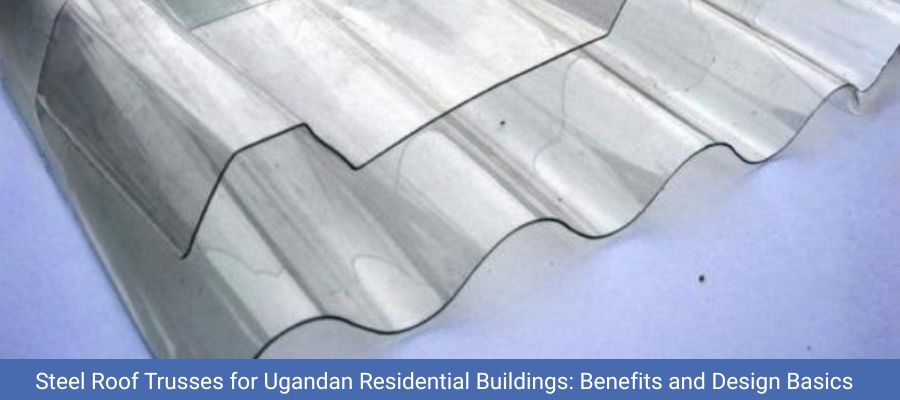
A roof truss is a pre-fabricated structural framework that supports the roof covering—whether iron sheets, clay tiles, concrete tiles, or polycarbonate—of a building. Instead of relying on internal load-bearing walls to support the roof, a truss transfers all roof loads to the building’s external walls through a triangulated framework of steel members.
Steel roof trusses are fabricated from:
At Build Matt, all residential steel roof trusses are designed by qualified structural engineers and fabricated from quality-certified mild steel in our Kampala workshop, then delivered to site as completed units ready for crane-erection.
The advantages of steel roof trusses over timber trusses in Uganda’s context are significant and well-documented by Build Matt’s 20 years of experience:
The span of a roof truss is the horizontal distance between the two external walls that the truss bridges. Choosing the right truss span is the first step in residential steel roof truss design.
Common residential building spans in Uganda and the appropriate steel truss approach:
Build Matt’s engineering team will advise on the most cost-effective truss configuration for your specific building span and roof load requirements.
The pitch of a roof is the angle of the roof surface, expressed in degrees or as a ratio of rise to span. Pitch selection for Ugandan residential buildings is influenced by:
Build Matt fabricates steel roof trusses at any pitch angle from 5° to 45°, designed specifically for the roof covering material and regional wind and rain conditions of the building’s location.
Roof truss engineers calculate the structural design of steel trusses based on the combined effect of several load types. Here is a plain-language explanation for non-engineers:
Dead Load
Dead load is the permanent weight of the roof structure itself—the weight of the roof sheets, purlins, insulation, ceiling boards, and the truss steel. For a typical corrugated iron sheet roof in Uganda, the dead load is approximately 0.15 to 0.20 kN/m² of roof area. Clay tile roofs impose a much higher dead load of 0.50 to 0.80 kN/m².
Live Load
Live load accounts for people and equipment that may temporarily be on the roof during maintenance or construction. Ugandan building regulations typically specify a maintenance live load of 0.25 to 0.50 kN/m² for residential roofs.
Uganda is not in a high-wind zone, but localized storms can produce significant wind pressures, particularly in open highland areas near Mt. Elgon, the Rwenzori, or on lakeshores. Wind acts both as a downward pressure on the windward roof slope and as an upward suction (uplift) force on the leeward slope. Steel roof truss designs must resist both effects.
If gutters block or drains fail, rainwater can pool on flat or low-pitch roof sections. A water depth of just 25 mm imposes a load of 0.25 kN/m²—significant for lightweight roof structures. Build Matt’s engineers account for water ponding in flat and low-pitch roof truss designs.
The truss engineer combines all these loads, applies safety factors, and selects steel section sizes that keep stresses within allowable limits for the steel grade specified. Build Matt provides structural design calculations and drawings for all steel roof truss projects in Uganda.
Steel roof truss pricing in Uganda depends on several factors:
Build Matt provides detailed quotations based on building dimensions, roof design, and local conditions. Contact Build Matt’s Kampala office for a free residential steel roof truss quotation.
Yes, in most cases. Steel roof trusses are completely immune to termites, do not rot, maintain consistent dimensions without shrinking or swelling, and can span wider distances without intermediate columns. In Uganda's climate, the long-term advantages of steel trusses over timber are significant and well-established.
Build Matt fabricates steel roof trusses for spans from 4 m for small outbuildings to over 25 m for large halls and commercial buildings. For standard residential bedrooms and living rooms, spans of 6 m to 12 m are most common. Build Matt's engineers will design the optimal truss configuration for your specific building.
Standard truss spacing for residential buildings in Uganda is 1,800 mm to 2,400 mm centres (1.8 m to 2.4 m apart). Closer spacing reduces the size of purlins required but increases the number of trusses. Build Matt's engineers calculate the most cost-effective spacing for each project.
Hot-dip galvanizing is strongly recommended for all steel roof trusses in Uganda, particularly in humid or exposed locations. Galvanizing provides 20 to 30 years of corrosion protection. At a minimum, steel trusses should be treated with a zinc-rich primer and polyurethane topcoat.
For a standard three-bedroom house, Build Matt can typically fabricate and deliver steel roof trusses within one to two weeks of design confirmation. Erection on site typically takes one to two days depending on roof complexity and site access. Contact Build Matt for a specific timeline for your project.

Founder & CEO
Mukesh Patel is the Founder & CEO of Build Matt ltd, specializing in Pre-Engineered Buildings (PEB) and general steel fabrication. With advanced technology, modern machinery, and a skilled workforce, he delivers efficient and high-quality solutions across East and Central Africa, including Uganda, Kenya, Tanzania, Congo, South Sudan, Rwanda, and Burundi.