
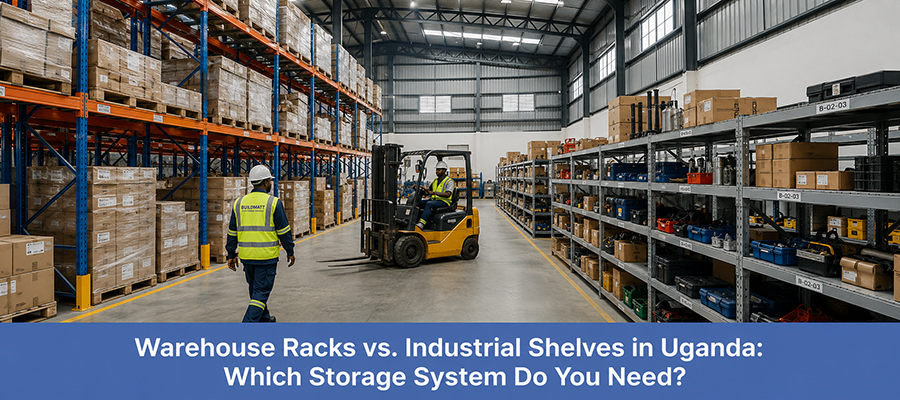
Warehouse Racks vs. Industrial Shelves in Uganda: Which Storage System Do You Need?
July 10, 2026
Share At:




Listening Article
AI Summary
Industrial shelves suit light to medium loads with direct manual access, while warehouse racks handle heavy, palletized inventory with forklift access and greater vertical storage. Steel shelves and commercial racks fill more specific roles in between. Build Matt manufactures and installs industrial storage systems across Uganda, using tested steel and site specific engineering, and supplies importers, distributors, wholesalers, contractors, architects, developers and procurement teams sourcing storage solutions for the East African market.
Warehouse Racks vs Industrial Shelves in Uganda: What Businesses Need to Know
Every warehouse, workshop and distribution centre in Uganda eventually faces the same question: should you invest in industrial shelves or warehouse racks? The two terms are often used interchangeably, yet industrial shelves and industrial racks serve different storage needs, hold different weight capacities and suit different types of businesses. Choosing the wrong storage system leads to wasted floor space, slow picking operations and, in some cases, structural failure and stock damage, a decision that matters as much to importers, distributors, wholesalers, contractors, architects, developers and procurement teams as it does to warehouse managers.
At Build Matt, we design, manufacture and install industrial storage systems for warehouses, factories, retail stores and distribution centres across Uganda. This guide breaks down the real differences between industrial shelves, steel shelves, industrial racks, warehouse racks and commercial racks, covering storage capacity, load requirements, accessibility, warehouse space, durability and cost, so you can select and specify the right storage system for your products, your space and your budget.
Speak with an Expert
 Call Us Now!
What Are Industrial Shelves and Warehouse Racks?
What Is an Industrial Shelf?
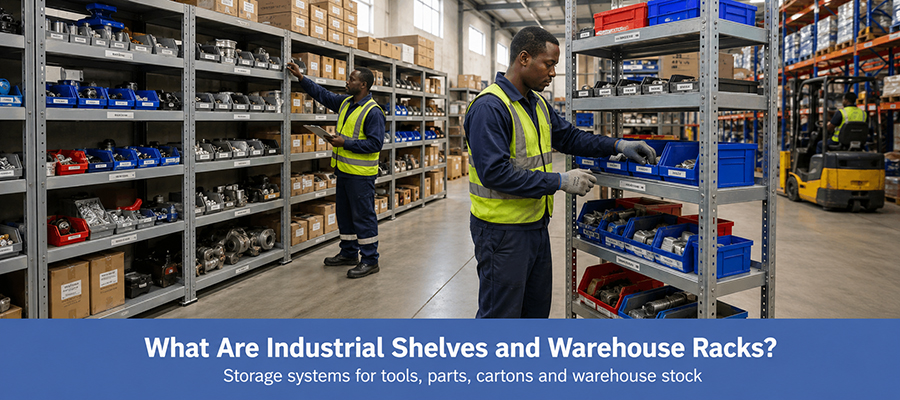
An industrial shelf is a fixed or adjustable steel storage unit made of horizontal levels supported by upright frames. It is designed for storing smaller, lighter items such as tools, spare parts, cartons and components that are handled manually. Industrial shelves are common in workshops, stockrooms, spare parts stores and small warehouses where forklifts are not always required.
What Are Industrial Shelves Used For?
Industrial shelves are used to organise loose items, boxed goods, tools, electrical components, automotive parts and retail stock. They allow direct hand picking, keep inventory visible and make stock counting faster. Businesses handling many small stock keeping units, rather than bulk pallets, generally rely on shelving rather than racking.
What Is an Industrial Rack?
An industrial rack, often called a warehouse rack, is a heavy duty steel structure built to store palletized goods in bulk. Racks use horizontal beams connected to vertical upright frames, creating multiple levels that a forklift can access. Industrial racks are engineered to carry significantly higher loads per level than standard shelving, making them the standard choice for large scale storage.
How Are Commercial Racks Different from Industrial Racks?
Commercial racks are generally lighter duty systems used in retail stores, supermarkets and display areas, where the goal is product presentation as much as storage. Industrial racks, by contrast, are structurally reinforced for warehouse and distribution centre use, where load capacity, beam strength and long term durability under continuous handling matter far more than appearance. Whether you need light duty shelving for a stockroom or heavy duty racking for a bulk warehouse, Build Matt manufactures both industrial shelves and industrial racks in Uganda, so you get the correct product for your storage type rather than a generic, one size fits all unit.
Industrial Shelves vs. Industrial Racks: What Is the Difference?
Storage Capacity and Load Requirements
Industrial shelves typically carry light to medium loads per level, generally suited to boxed goods, parts and manually handled stock. Industrial racks are engineered for medium to very heavy loads, often supporting palletized goods weighing several hundred kilograms per beam level, depending on the rack design and steel gauge used.
Shelf Levels and Vertical Storage
Shelving units usually offer moderate vertical storage, often limited by what a person can safely reach or a step ladder can access. Racks are built to maximise vertical space, frequently rising several metres high, with forklifts or reach trucks retrieving pallets from upper levels.
Accessibility and Product Handling
Shelves allow direct manual access, so staff can pick individual items quickly without equipment. Racks generally require forklift or pallet jack assistance, since goods are stored on pallets rather than loose. This difference affects staffing, equipment costs and picking speed.
Floor Space and Warehouse Layout
Shelving suits narrower aisles and smaller footprints, making it efficient for compact stores and workshops. Racking requires wider aisles for forklift manoeuvring, but because it stores goods higher and in bulk, it often delivers better storage density per square metre in large warehouses.
Durability and Long-Term Use
Both systems, when built from quality steel and properly installed, offer long service life. However, racks are generally engineered to withstand repeated heavy impact from forklift operations and continuous heavy loading, while shelves are built for lighter, steadier use with less mechanical impact. Build Matt assesses your load requirements, vertical space and handling method before recommending a system, so you are not left guessing whether shelving or racking fits your operation, with every design matched to your actual products rather than a standard catalogue size.
Quick Response Guaranteed
Email Us Now!
When Should You Choose Industrial Shelves in Uganda?
Industrial Shelves for Small and Medium Warehouses
If your storage space is limited and your inventory consists mainly of smaller items rather than bulk pallets, industrial shelves make better use of available floor space and keep operating costs lower than a full racking system.
Steel Shelves for Tools, Components and Spare Parts
Steel shelves are ideal for storing tools, mechanical spare parts, electrical components and small hardware items. Their open, tiered design keeps stock organised, visible and easy to retrieve without machinery.
Industrial Shelving for Workshops and Factories
Workshops and factories in Uganda often need shelving near production lines for quick access to frequently used items. Industrial shelving supports this fast pick, fast restock environment far better than bulk racking.
When Commercial Racks May Be More Suitable
If your business is retail focused and storage doubles as product display, lighter duty commercial racks may be more suitable than heavy industrial shelving, since they balance moderate load capacity with a more presentable finish. Build Matt manufactures steel shelving in a range of sizes and load ratings for workshops, spare parts stores and small to medium warehouses across Uganda, with custom shelf depth, height and divider options built around what you actually store.
When Should You Choose Industrial Racks in Uganda?
Heavy-Duty Industrial Racks for Warehouses
Businesses storing bulk inventory, raw materials or heavy goods need heavy duty industrial racks capable of carrying substantial loads safely across multiple levels, without deflection or structural strain.
Industrial Racks for Palletized Goods
If your goods arrive and move on pallets, racking is the logical choice. Pallet racks are designed around standard pallet dimensions and forklift access, streamlining loading, unloading and stock rotation.
Commercial Racks for Retail and Distribution Storage
Distribution centres supplying retail chains often use a combination of heavy duty racks for bulk storage and commercial racks for order picking and staging areas, balancing capacity with operational speed.
Choosing Racks for High-Volume Inventory
High volume operations, such as FMCG distribution and manufacturing warehouses, benefit from racking because it supports dense vertical storage, reducing the warehouse footprint required per unit of inventory stored. Build Matt designs and installs heavy duty pallet racking engineered for Ugandan warehouse conditions, with beam and frame specifications calculated for your actual pallet weights, not assumed averages, so your racking performs safely at full capacity.
Steel Shelves vs. Industrial Racks: How Much Weight Can They Handle?
Load capacity depends on the steel gauge, frame design, beam length and how the system is anchored to the floor. As a general guide used across the storage industry:
- Light duty steel shelves: suited to smaller, hand loaded items, with each shelf level supporting light to moderate weight.
- Medium duty steel shelves: suited to boxed inventory and moderate volumes of stock per level.
- Light to medium duty racks: suited to smaller pallets or mixed manual and forklift handling.
- Heavy duty industrial racks: engineered for full pallet loads per beam level, with capacity confirmed through structural design calculations rather than estimation.
Because exact capacities vary by design, reputable storage providers calculate load ratings using recognised engineering standards rather than fixed assumptions. In the United States, for example, the American National Standards Institute publishes ANSI MH16.1, the Design, Testing and Utilization of Industrial Steel Storage Racks standard, developed with the Rack Manufacturers Institute, which sets structural design and testing requirements for industrial racking. Build Matt applies similar engineering discipline when designing racks and shelves for the Uganda market, factoring in beam capacity, weight distribution, upright frame strength and floor loading before recommending a system, and shares the resulting capacity figures with every client so they know exactly what their storage system can safely hold.
How to Choose Between Industrial Shelves and Racks for Your Uganda Warehouse?
Type of Products Being Stored
Small, loose or boxed items suit shelving. Palletized, bulk or heavy items suit racking. Mixed inventory often needs a combination of both.
Product Weight and Dimensions
Heavier and bulkier products require racks engineered for higher load ratings, while lighter items are handled efficiently on standard steel shelving.
Available Warehouse Space
Limited floor space with average ceiling height favours shelving. Larger footprints or high ceilings allow racking to maximise vertical storage and improve space utilisation.
Required Storage Capacity
Businesses expecting to store large stock volumes should size their racking system around projected inventory growth, not just current stock levels.
Manual vs. Forklift Handling
If your team picks stock by hand, shelving keeps operations simple. If forklifts are already part of your workflow, racking integrates more efficiently.
Future Storage Expansion
Modular racking and shelving systems allow businesses to expand storage capacity as inventory grows, without redesigning the entire warehouse layout. Build Matt offers a site assessment for businesses across Uganda, reviewing your product type, warehouse space, handling method and growth plans before recommending whether shelving, racking or a combination is the right fit.
Industrial Shelf Manufacturers vs. Industrial Rack Manufacturers in Uganda
Selecting between shelves and racks is only half the decision. The manufacturer behind the system determines how safely and how long it performs, which is why procurement teams, contractors and distributors comparing suppliers should look past price alone.
What to Look for in Industrial Shelf Manufacturers
Look for manufacturers who use consistent steel gauges, proper welding or bolting techniques and finish coatings that resist rust in Uganda’s humid conditions.
What to Look for in Industrial Rack Manufacturers
Rack manufacturers should provide documented load capacities, structural calculations and beam connector systems tested for repeated forklift loading and unloading cycles.
Custom Manufacturing Capabilities
Every warehouse has a different layout. Build Matt manufactures custom industrial shelves and racks built to specific height, width, depth and load requirements, rather than offering only fixed sizes.
Material and Steel Quality
Steel quality directly affects load capacity and lifespan. Build Matt sources and processes steel that meets recognised quality benchmarks, in line with the standards enforced by the Uganda National Bureau of Standards for steel products used in construction and industrial applications.
Load Testing and Structural Quality
Before installation, rack and shelf designs should be checked against expected load requirements. Build Matt reviews structural design and load distribution for every project, rather than relying on generic specifications.
Installation and After-Sales Support
A manufacturer that also installs and supports its systems reduces the risk of assembly errors. Build Matt provides installation, anchoring and after-sales support across Uganda, so businesses are not left to self-assemble heavy duty steel structures. As both manufacturer and installer, Build Matt controls quality from raw steel through to final anchoring on your warehouse floor, giving you a single accountable partner rather than juggling separate manufacturers, suppliers and installation contractors.
We are Available on Chat, Call, Email!
Email!
Industrial Shelf Suppliers vs. Industrial Rack Suppliers in Uganda
When to Buy from a Local Industrial Shelf Supplier
Buying locally in Uganda reduces lead times, shipping costs and the risk of import delays, while allowing easier communication for custom sizing and repeat orders. For importers and wholesalers used to sourcing storage equipment from overseas, a local manufacturer also simplifies after sales support and spare part replacement.
Choosing an Industrial Rack Supplier
A reliable rack supplier should be able to explain load ratings, beam spacing and frame specifications clearly, not just quote a price per unit.
Product Availability and Customization
Stock availability matters for businesses that need to expand storage quickly. Build Matt maintains manufacturing capacity in Uganda to produce both standard and custom shelving and racking without long import waiting periods.
Delivery and Installation Considerations
Delivery timelines, site access and installation logistics should be planned before ordering, particularly for large racking systems that require professional assembly and anchoring.
Supplier Experience with Industrial Warehouses
Experience matters. Suppliers who have worked across manufacturing, FMCG, retail and logistics warehouses understand the practical challenges of each sector, rather than applying a one size fits all approach. As a local Uganda based manufacturer and supplier, Build Matt cuts down import wait times, offers direct pricing without middlemen, and can scale production up as your storage needs grow across multiple sites.
Industrial Shelf Builders and Rack Builders: Custom Storage Solutions
When Do You Need Custom Industrial Shelves?
Custom shelving is needed when standard sizes do not fit irregular spaces, low ceilings, columns or unusually shaped storage rooms.
Custom Industrial Rack Design
Custom rack design becomes necessary when pallet sizes, aisle widths or building height fall outside standard configurations, requiring tailored beam lengths and frame heights.
Shelf and Rack Dimensions
Dimensions should be based on actual product sizes, pallet footprints and available building height, not estimated averages, to avoid wasted space or unsafe overloading.
Custom Load Requirements
Businesses storing unusually heavy or oversized items need load requirements calculated specifically for those products, rather than assumed from standard catalogue ratings.
Warehouse-Specific Storage Solutions
Build Matt designs storage layouts around the specific warehouse, factoring in column placement, doorway height, floor strength and workflow, rather than fitting a warehouse around generic shelving and racking units. This makes it easier for architects and developers to plan storage capacity into a facility at design stage, rather than retrofitting it later. Its in house design and fabrication process means custom shelf and rack dimensions are built to your exact site measurements, so irregular spaces, low ceilings and non standard pallet sizes are accommodated rather than worked around.
Industrial Shelf Contractors and Rack Contractors in Uganda
What Does an Industrial Storage Contractor Do?
An industrial storage contractor manages the design, supply, assembly and anchoring of shelving and racking systems, ensuring the finished installation is stable, level and compliant with safe loading practices.
Rack and Shelf Installation
Correct installation affects long term safety. Poorly assembled racks and shelves are a leading cause of collapse, even when the steel itself is high quality.
Warehouse Layout and Installation
Installation should account for aisle width, forklift turning radius, fire exits and load paths, integrating storage into the overall warehouse layout rather than treating it as a standalone task.
Safety and Anchoring
Racks and shelves should be properly anchored to the floor and, where required, braced against walls or adjoining units to prevent tipping under load or impact.
Choosing the Right Industrial Storage Contractor
Choose a contractor who manufactures, delivers and installs the system, since accountability across the full process reduces the risk of mismatched components or installation shortcuts. Build Matt manages this process end to end for businesses across Uganda, with installation teams that handle anchoring, bracing and layout planning on site, so racking and shelving are installed to safe loading standards from day one, with no gap between manufacturer and installer.
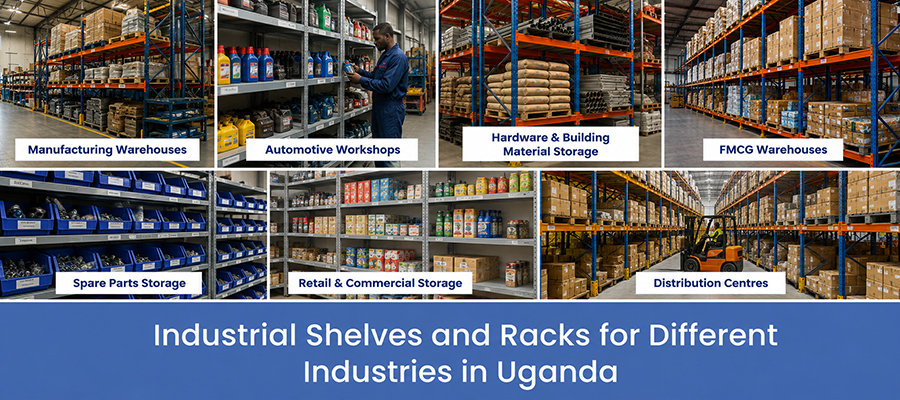
Industrial Shelves and Racks for Different Industries in Uganda
Manufacturing Warehouses
Manufacturing facilities use racking for raw materials and bulk components, alongside shelving for tools and smaller production items near the line.
Automotive Workshops
Automotive workshops rely heavily on steel shelving to organise spare parts, filters, fluids and tools by category for fast retrieval.
Hardware and Building Material Storage
Hardware stores and building material yards use a mix of heavy duty racking for bulky items like cement and steel bars, and shelving for smaller fittings and tools.
FMCG Warehouses
Fast moving consumer goods warehouses depend on racking for palletized stock rotation, supporting high turnover and efficient loading and offloading.
Spare Parts Storage
Spare parts operations benefit from steel shelving with labelled bins, improving stock accuracy and reducing time spent searching for components.
Retail and Commercial Storage
Retail backrooms and stockrooms often use commercial racks and shelving together, balancing storage capacity with quick restocking of the shop floor.
Distribution Centres
Distribution centres typically require the highest storage density, making heavy duty industrial racking, combined with clear aisle planning, essential to operational efficiency. Build Matt has supplied and installed storage systems across manufacturing, automotive, hardware, FMCG, retail and distribution businesses in Uganda, and applies that sector specific experience to recommend the right shelving and racking mix for your industry.
Industrial Steel Shelves or Warehouse Racks: Which One Should You Choose?
| Factor | Industrial Shelves | Warehouse Racks |
|---|---|---|
| Storage Type | Smaller individual items | Pallets and bulk goods |
| Load Requirement | Light to medium/heavy | Medium to very heavy |
| Accessibility | Direct manual access | Often forklift assisted |
| Vertical Storage | Moderate | High |
| Best For | Parts, tools, boxes | Pallets, bulk inventory |
| Warehouse Size | Small to medium | Medium to large |
| Aisle Width Needed | Narrow, walk-in access | Wide, forklift turning radius required |
| Handling Equipment | Minimal, mostly manual | Forklift, reach truck or pallet jack |
| Picking Speed | Fast for individual items | Fast for bulk pallet movement |
| Space Utilisation | Efficient for small footprints | Efficient for high-volume, tall spaces |
| Structural Design | Standard steel frames and levels | Engineered uprights, beams and connectors |
| Typical Industries | Workshops, spare parts stores, retail backrooms | FMCG, manufacturing, distribution centres |
| Installation Complexity | Simple, faster assembly | Requires professional anchoring and bracing |
| Customization | Adjustable levels, bin and divider options | Custom beam length, frame height and bay width |
| Maintenance Needs | Low, occasional inspection | Regular inspection due to forklift impact risk |
| Relative Investment | Lower upfront cost | Higher upfront cost, better cost per pallet stored at scale |
Still unsure which column fits your business? Build Matt reviews your product weight, warehouse size and handling method against this exact comparison and recommends a system, or a combination of both, matched to your operation rather than a generic default.
How to Find the Right Industrial Shelf & Rack Manufacturer in Uganda
Manufacturing Capability
Confirm the manufacturer has in-house production capacity in Uganda, rather than acting purely as a reseller of imported units.
Steel Quality
Ask what steel grade and gauge is used, and whether it aligns with quality benchmarks referenced by the Uganda National Bureau of Standards.
Load Capacity
Request documented load capacity figures per shelf level or rack beam, based on the specific design, not generic marketing claims.
Customization
Check whether the manufacturer can adjust height, width, depth and finish to match your warehouse rather than only offering fixed configurations.
Installation
Confirm whether installation, anchoring and safety checks are included, since proper assembly is as important as the steel itself.
Warranty and Support
A manufacturer offering warranty coverage and after-sales support signals confidence in their build quality and gives you recourse if issues arise. Build Matt meets each of these criteria in house, combining local manufacturing, tested steel, documented load capacity, full customization, professional installation and after sales warranty support, all from one accountable Uganda based partner. Explore our storage solutions at buildmatt.net or reach out for a site assessment and quotation.
FAQs About Industrial Shelves and Warehouse Racks in Uganda
Industrial shelves are designed for lighter, manually handled items on multiple levels, while industrial racks are heavy duty structures built to store palletized goods, usually with forklift access.
It depends on your inventory. Warehouses storing bulk palletized goods benefit more from racking, while those storing smaller mixed items are better served by shelving, and many warehouses use both.
Capacity varies by steel gauge, frame design and shelf spacing, ranging from light duty to heavy duty ratings. Always request documented capacity figures rather than relying on estimates.
Heavy duty racks are used to store palletized inventory, raw materials and bulk goods in warehouses, manufacturing plants and distribution centres, where high load capacity and vertical storage are priorities.
Consider the type and weight of goods stored, available floor space and ceiling height, whether forklifts are used, and expected future storage growth.
Ask about steel quality, load capacity per shelf, customization options, delivery timelines and whether installation support is included.
Look for local manufacturing capability, documented load testing, custom design options and a track record of installations across similar industries.
Steel shelves generally offer higher load capacity, greater durability and better resistance to pests and moisture compared to wooden shelving, making them the standard choice for industrial environments.
Yes, shelving can be customised in height, width, depth and number of levels to match the products stored and the available space.
A manufacturer produces the racking system, while a supplier may distribute manufactured units, sometimes imported. Buying from a manufacturer, such as Build Matt, often means better customization and more direct accountability.
Reputable contractors provide full installation, including anchoring and safety checks, rather than leaving assembly entirely to the client.
Storage systems should be visually inspected regularly and undergo a more thorough structural inspection at least annually, or sooner if impact damage, overloading or corrosion is observed, in line with general industrial storage safety practice.
Build Matt manufactures, customises, delivers and installs both industrial shelves and warehouse racks across Uganda, backed by tested steel, documented load capacities and after sales support, giving you one accountable partner for your entire storage project.

Founder & CEO
Mukesh Patel is the Founder & CEO of Build Matt ltd, specializing in Pre-Engineered Buildings (PEB) and general steel fabrication. With advanced technology, modern machinery, and a skilled workforce, he delivers efficient and high-quality solutions across East and Central Africa, including Uganda, Kenya, Tanzania, Congo, South Sudan, Rwanda, and Burundi.
Recent Blogs
- Metal Stairs and Railings for Industrial Facilities: Safety, Design and Installation Considerations
- Free Standing Mezzanines vs Building Supported Mezzanines: Which Solution Is Right for Your Warehouse?
- Steel Industrial Rack vs Commercial Rack: Understanding the Key Differences for Businesses
- How to Design a Car Parking Structure for Multiple Vehicles and Maximum Space Efficiency
- How to Choose the Right Shade Structure for Balconies, Windows and Outdoor Spaces