

Read Our Article
The Rise of Mezzanine Floors in Uganda’s Warehousing and Logistics BoomSteel Mezzanine Floors for Cold Storage and Pharmaceutical Warehouses in Uganda
June 4, 2026
Share At:




Listening Article
AI Summary
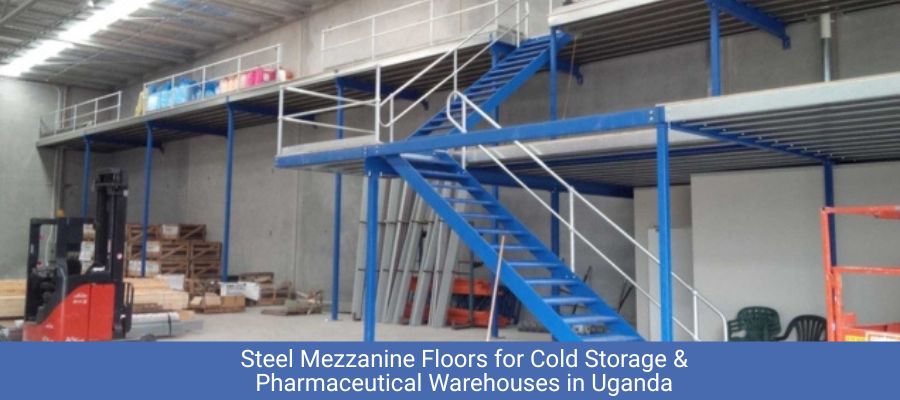
Cold storage and pharmaceutical warehouses are among the most demanding environments for structural steelwork in Uganda. Temperature extremes, humidity cycling, chemical cleaning agents, regulatory compliance requirements (WHO-GDP, EFMHACA, NDA), and stringent hygiene standards create a specification brief for mezzanine floors that differs fundamentally from a conventional warehouse mezzanine. Build Matt Ltd. — Uganda’s leading mezzanine floor manufacturer, fabricator, and installer — explains the design principles, material choices, surface specifications, load considerations, and regulatory compliance implications for steel mezzanine floors in Uganda’s cold chain and pharmaceutical warehousing sector. This guide serves facility planners, pharmaceutical logistics managers, architects, and warehouse operators who are specifying or procuring mezzanine floor systems for these specialised environments.
Why Cold Storage and Pharmaceutical Warehouses in Uganda Need Specialist Mezzanine Floors
Uganda’s cold chain and pharmaceutical storage sectors are growing rapidly. The expansion of fresh produce exports (flower and vegetable exports to Europe), the rollout of Uganda’s National Immunisation Programme and COVID-19 vaccine cold chain, and the growth of formal pharmaceutical retail through national pharmacy chains have created demand for a new generation of temperature-controlled warehousing that meets international standards.
When a warehouse operator, pharmaceutical company, or cold chain logistics provider decides to install a steel mezzanine floor in a temperature-controlled or pharmaceutical-grade storage facility, they face a set of technical challenges that do not exist in a conventional ambient-temperature warehouse:
- Thermal bridging: Steel is an excellent conductor of heat. In a cold store, exposed steel mezzanine structural members that penetrate from the cold interior to an ambient-temperature area can create thermal bridges — pathways for heat to enter the cold space — that increase refrigeration energy consumption, cause condensation on structural members, and compromise temperature uniformity.
- Condensation and hygiene: Temperature differentials between cold store interiors and warmer ambient air — particularly during loading operations when doors are open — cause moisture to condense on uncoated or inadequately protected steel surfaces. In pharmaceutical warehouses, condensation that drips onto product packaging or racking is a serious contamination risk and a WHO-GDP compliance failure.
- Chemical resistance: Cold stores and pharmaceutical warehouses are cleaned with strong disinfectants, sanitisers, and sometimes acid or alkali cleaners. The floor and structural surfaces of mezzanine systems in these environments must resist chemical attack without degrading, corroding, or releasing contaminating particles.
- Temperature cycling: Structural steel in cold stores undergoes daily temperature cycling — expanding and contracting as cooling cycles run and loading operations introduce warm ambient air. Structural connections and surface coatings must accommodate this thermal movement without loosening, cracking, or delaminating.
- Regulatory compliance: Pharmaceutical warehouses in Uganda must comply with NDA (National Drug Authority) licensing requirements, WHO Good Distribution Practice (GDP) guidelines, and — for export-oriented cold chain operators — EU, US FDA, or other international regulatory frameworks. Mezzanine floor systems must be specified and documented to support these compliance frameworks.
Load Design for Pharmaceutical and Cold Store Mezzanine Floors
The load-bearing specification of a mezzanine floor is the starting point for its structural design. In pharmaceutical and cold storage applications, the loads are often significantly higher than in conventional offices or light storage mezzanines:
Need More Information?
Email Us Today!
Pharmaceutical Warehouse Mezzanine Loads
- Pharmaceutical product in cartons on shelving: Typically 3.0 to 5.0 kN/m² (300 to 500 kg per square metre) live load for shelved pharmaceutical product in cartons or on pallet racking.
- Order picking activity: Where mezzanine floors are used for order assembly and picking, allowance for 2 to 3 operatives per bay plus picking trolleys — typically 2.0 to 3.0 kN/m² live load.
- Pallet loads: If counterbalance or reach trucks will operate on the mezzanine floor — an unusual but not unprecedented design — the structural design must account for axle loads of 5 to 15 tonnes. Build Matt does not recommend conventional mezzanine floors for forklift operation; instead, a fully engineered structural slab on ground or an elevated reinforced concrete slab supported on steel structure is the appropriate solution.
Build Matt’s standard pharmaceutical warehouse mezzanine is designed for a 5.0 kN/m² live load — adequate for all manual and semi-mechanical pharmaceutical product handling operations.
Cold Store Mezzanine Loads
Cold store mezzanine floors carrying racking with temperature-controlled product (meat, dairy, fish, vaccines) are designed for:
- Racking loads: 4.0 to 7.5 kN/m² live load depending on racking height, product density, and bay configuration.
- Dynamic loads: In automated cold stores or where motorised order pickers operate, dynamic load factors of 1.25 to 1.5 times the static live load are applied.
- Snow and ice load: Not applicable in Uganda’s tropical climate, but ice accumulation from product or condensation is factored into floor surface load calculations for blast-freeze facilities.
Our Other Product
Prefabricated Showrooms & Commercial Building StructuresMaterial Specification: What Works in Cold Store and Pharmaceutical Mezzanine Environments
Structural Steel: Grade and Treatment
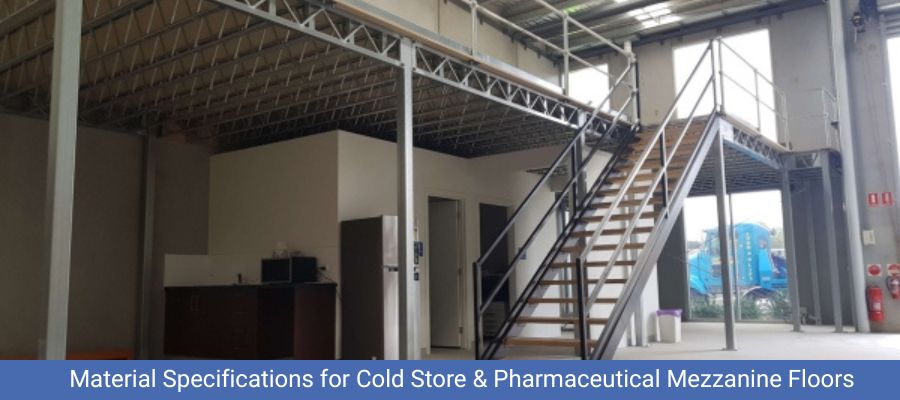
Build Matt uses Grade S275 structural steel (conforming to BS EN 10025) for pharmaceutical and cold store mezzanine structural members — columns, primary beams, secondary beams, and bracing. S275 steel provides adequate strength for the required loads while remaining weldable and formable for the precision connections required in hygiene-critical applications.
Surface treatment of structural steel for cold store and pharmaceutical mezzanine applications:
- Hot-dip galvanizing: The preferred primary treatment for cold store mezzanine structural members. Hot-dip galvanizing provides complete coverage of all surfaces including internal faces of hollow sections, weld zones, and connection areas — critical in environments where condensation can attack any unprotected surface. Galvanized steel in cold stores does not corrode even under prolonged condensation exposure.
- Epoxy coating over galvanizing: For pharmaceutical warehouses where a smooth, chemical-resistant, and visually inspectable surface is required, Build Matt applies a two-coat epoxy system (primer + topcoat, total 150–200 microns) over the galvanized structural members. The epoxy topcoat provides chemical resistance to the cleaning agents used in pharmaceutical facilities and a smooth surface that does not harbour bacteria.
- Stainless steel (Grade 316): The premium specification for pharmaceutical mezzanine components in the highest-risk environments — particularly for food-grade pharmaceutical warehouses or cleanroom-adjacent storage. Grade 316 stainless steel columns and beam sections are available from Build Matt for projects where the pharmaceutical client specifies stainless steel as a site standard.
Decking: The Mezzanine Floor Surface
The choice of mezzanine decking material is critical in cold store and pharmaceutical applications:
- Open-bar steel grating (standard industrial mezzanine): Not appropriate for cold store or pharmaceutical applications. Open grating allows product, dust, and liquids to fall through to the level below, creating contamination risk. It also makes cleaning of the mezzanine surface area difficult.
- Checker plate (diamond pattern) steel floor: Suitable for some cold store mezzanine applications where product is on pallets rather than loose on the floor. Provides an anti-slip, solid surface that can be cleaned. Build Matt supplies hot-dip galvanized checker plate for cold store mezzanines.
- Solid smooth steel plate with epoxy floor coating: The recommended decking for pharmaceutical warehouse mezzanines. 5 mm or 6 mm solid steel floor plate, fully welded over the secondary beam structure, with a seamless two-component epoxy resin floor coating applied over the steel. The seamless epoxy coating eliminates joints, gaps, and recesses where bacteria and product contamination can accumulate — the same floor system used in pharmaceutical production rooms and cleanrooms.
- FRP (Fibreglass Reinforced Plastic) grating: An alternative for cold store mezzanines where an open-grid surface is acceptable for racking operations. FRP grating is non-conductive, non-corrosive, easy to clean, and will not rust in the cold, humid environment of a cold store. Build Matt can supply FRP grating on a steel structural frame as an alternative to steel decking in cold store applications.
Hygiene-Critical Design Details for Pharmaceutical Mezzanine Floors
Beyond material selection, the design details of a pharmaceutical or cold store mezzanine floor must reflect the hygiene requirements of the facility:
Coved Junctions
All junctions between the mezzanine floor surface and vertical structural members (columns, walls) should be finished with a coving — a concave curved fillet seal — rather than a right-angle joint. Right-angle junctions harbour bacteria, are impossible to clean effectively, and are specifically prohibited in pharmaceutical GMP environments. Build Matt applies polyurethane or epoxy coving compound at all floor-to-column and floor-to-wall junctions on pharmaceutical mezzanine installations.
Eliminating Horizontal Ledges and Cavities
Every horizontal ledge — the top surface of a horizontal structural beam, the top of a handrail, the flat top of a column cap — is a potential dust accumulation surface in a pharmaceutical warehouse. Build Matt’s pharmaceutical mezzanine designs minimise horizontal ledges by:
- Using sloped beam cap plates rather than flat caps — dust and drips run off rather than accumulating.
- Using round tube handrails rather than square hollow section — round tubes have no flat top surface.
- Sealing all hollow structural sections at their open ends with welded end plates or caps to prevent product from entering the hollow interior.
Drainage Provisions
Pharmaceutical mezzanine floors are cleaned by wet mopping or low-pressure washing. Drainage provisions in the mezzanine floor — either floor drains or sloping the mezzanine floor toward a collection gutter — must be designed to prevent wash water from dripping onto the storage area below or onto product on the level below. Build Matt designs pharmaceutical mezzanine floors with a minimum 2 mm/m slope toward floor drainage points.
Our Other Product
Steel Furniture & Custom Fabrication for Office & Industrial Workshop
Let’s Discuss! Request a Call Now!
 Call Now!
Regulatory Documentation for Pharmaceutical Mezzanine Floors
Uganda’s NDA requires pharmaceutical warehouse facilities to maintain detailed documentation of their physical infrastructure as part of GDP compliance. Build Matt provides pharmaceutical and cold store mezzanine clients with:
- Structural design calculations confirming the mezzanine’s design load capacity — essential for the facility’s Site Master File (SMF) under WHO-GDP.
- Material certificates for all structural steel confirming grade and standard.
- Surface treatment records confirming galvanizing or coating specification and measured dry film thickness.
- As-built drawings showing the complete mezzanine layout, beam sizes, column positions, and floor details.
This documentation package supports the regulatory inspection process and demonstrates that the mezzanine floor has been engineered, fabricated, and installed to a documented and verifiable standard.
Frequently Asked Questions (FAQs)
Standard warehouse mezzanine floors typically use open-bar grating decking and uncoated or minimally coated structural steel. In a cold store, open grating creates contamination risk and cleaning challenges, while uncoated steel corrodes rapidly under the condensation and humidity cycling that cold stores experience. Build Matt designs cold store mezzanines with galvanized or epoxy-coated structural steel and solid or FRP decking appropriate for the cold, humid, and chemically cleaned environment.
Build Matt recommends seamless two-component epoxy resin floor coating over solid steel plate decking for pharmaceutical warehouse mezzanines in Uganda. This combination provides a smooth, seamless, chemically resistant, and easily cleaned floor surface that meets WHO-GDP hygiene requirements and NDA pharmaceutical facility standards. The epoxy coating eliminates the joints and recesses where bacteria can accumulate on alternative floor surfaces.
Yes, when properly designed. Build Matt's cold store mezzanine structural connections are designed with expansion provisions — slotted bolt holes in secondary beam connections and expansion gaps in the decking — to accommodate the thermal movement of steel between cold store operating temperature (typically -2°C to +8°C for chilled storage, -18°C to -25°C for frozen storage) and ambient temperature during maintenance and loading operations.
Build Matt's standard cold store mezzanine floor is designed for a live load of 5.0 kN/m² (500 kg/m²), which is suitable for racking with chilled pharmaceutical product, fresh produce, or dairy products in standard pallet configurations. For blast freeze or high-density frozen product racking, higher design loads of 7.5 kN/m² may be specified. Build Matt's engineers calculate the required live load based on the client's specific racking and product configuration.
Yes. Build Matt provides a complete documentation package for pharmaceutical mezzanine installations including structural design calculations, material certificates, surface treatment records, and as-built drawings. This documentation is designed to support NDA facility inspections and WHO-GDP Site Master File requirements. Build Matt can also attend pre-inspection documentation reviews with clients on request.
Build Matt plans cold store mezzanine installations to minimise disruption to refrigeration operations. Structural steel erection can typically be completed in 2 to 5 days for a standard mezzanine module (10 m × 10 m), with decking and handrail installation adding 1 to 2 more days. Floor coating requires 24 to 48 hours' curing time before foot traffic. For operational cold stores, Build Matt works in planned maintenance windows and sequences the installation to minimise the area unavailable for product storage at any one time.

Founder & CEO
Mukesh Patel is the Founder & CEO of Build Matt ltd, specializing in Pre-Engineered Buildings (PEB) and general steel fabrication. With advanced technology, modern machinery, and a skilled workforce, he delivers efficient and high-quality solutions across East and Central Africa, including Uganda, Kenya, Tanzania, Congo, South Sudan, Rwanda, and Burundi.
Recent Blogs
- Metal Stairs and Railings for Industrial Facilities: Safety, Design and Installation Considerations
- Free Standing Mezzanines vs Building Supported Mezzanines: Which Solution Is Right for Your Warehouse?
- Steel Industrial Rack vs Commercial Rack: Understanding the Key Differences for Businesses
- How to Design a Car Parking Structure for Multiple Vehicles and Maximum Space Efficiency
- How to Choose the Right Shade Structure for Balconies, Windows and Outdoor Spaces