Build Matt Ltd.

  May 6, 2026
Share At:
Google AI ChatGPT Grok Perplexity

Listening Article

The Terminology in Uganda's Market: What People Mean by 'Godown' and 'Warehouse'

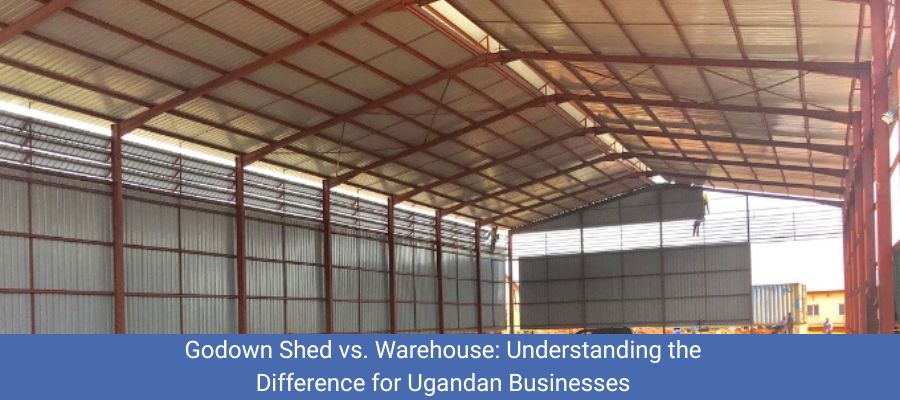
In the East African commercial context, the word ‘godown’ (derived from the Malay word ‘gadong’, meaning storage room) has been in use since the British colonial era to describe a simple, functional storage shed or building used to hold goods. In Uganda today, ‘godown’ typically refers to a relatively basic storage structure — often a single-storey metal-roofed shed with simple masonry or steel walls — used by traders, importers, manufacturers, and distributors to hold stock, materials, or goods.

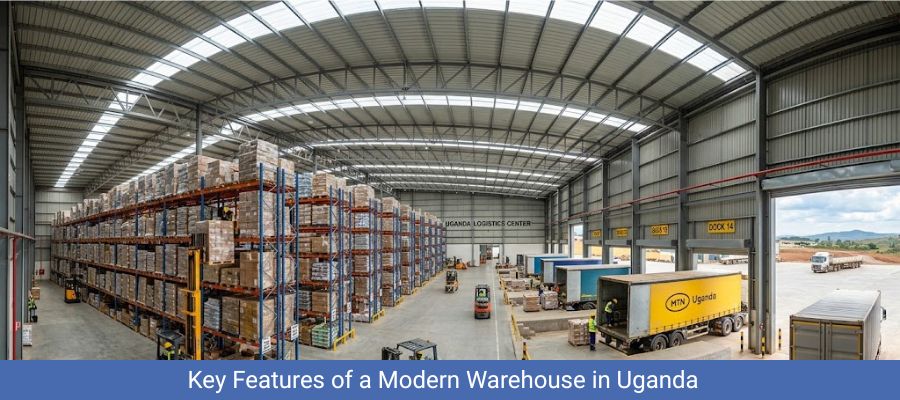
‘Warehouse’ in Uganda’s market tends to refer to a more purpose-engineered, larger, and operationally sophisticated storage facility — often a pre-engineered building (PEB) or a large-span steel structure with features including loading docks, wide-span clear-span interior space, higher eave heights, and infrastructure for mechanical handling equipment.

In reality, the boundary between these two terms is blurry — a large, well-built godown in Uganda can be functionally similar to a modest warehouse. What matters more than the label is understanding the specific features and standards relevant to your business’s storage requirements.

Let’s Discuss! Request a Call Now!
WhatsApp Call Now!

Defining the Godown Shed: Features, Standards, and Typical Uses

Physical Characteristics

A godown shed in Uganda’s market is typically characterised by:

  • Single-storey construction with eave heights of 3.5 m to 5.5 m — sufficient for manual stacking to 2–3 pallet heights, but limiting for mechanical handling equipment.
  • Simple structural system: masonry walls with a steel roof truss and corrugated iron sheet roofing, or a full steel structure frame with steel cladding on walls and roof.
  • One or two access doors (typically double-leaf hinged or roller shutter doors) as the primary access for loading and unloading.
  • Basic electrical lighting and minimal infrastructure — typically just power for lights and possibly a few single-phase power outlets.
  • Natural ventilation through louvred vents in the gable ends and roof ridge.
  • Concrete floor slab of 100–150 mm thickness — sufficient for foot traffic and light pallet truck loading.

Typical Users of Godown Sheds in Uganda

  • Small and medium import-export traders in Kampala’s Kikuubo, Nakasero, and Namirembe Road commercial districts storing fast-moving consumer goods.
  • Manufacturing SMEs storing raw materials, packaging, and finished goods.
  • Agricultural commodity traders storing grain, beans, coffee, and produce in rural district towns.
  • Construction materials dealers storing cement, tiles, iron bars, and timber.
  • NGO and government project stores for programme materials, emergency NFI kits, and equipment.

Prefab Godown / PEB Godown Structures

Build Matt’s Prefab Godown (also offered as PEB Godown or Steel Godown) uses a pre-engineered, fully steel frame structure — columns, roof trusses, wall girts, and roof purlins all fabricated from structural steel in our Kampala workshop — with corrugated steel cladding on walls and roof. This approach delivers a godown that can be erected in 5–10 working days for a 20 m × 30 m footprint, compared to 8–16 weeks for equivalent masonry construction.

Defining the Warehouse: Features, Standards, and Typical Uses

Physical Characteristics

A warehouse in Uganda’s industrial market is distinguished from a godown by:

  • Higher eave heights of 6.0 m to 12.0 m or more — creating clear interior space for racking systems, mechanical handling equipment (forklifts, reach trucks), and high-volume pallet storage.
  • Clear-span interior design: no internal columns obstructing the usable storage area. Build Matt’s warehouse structures achieve clear spans of 15 m to 40 m, depending on structural configuration.
  • Loading dock infrastructure: dedicated raised truck dock with dock levellers, hardstand yard for manoeuvring, and — in advanced facilities — dock seals and dock shelter canopies.
  • Heavier floor slab: 150–200 mm reinforced concrete floor slab, often with power-trowelled surface finish and concrete hardener, designed for forklift wheel loads of 5–10 tonnes per axle.
  • Sophisticated infrastructure: fire sprinkler systems, LED high-bay lighting, emergency lighting, CCTV, three-phase electrical supply for refrigeration and mechanical equipment, and mezzanine office space.
  • Advanced environmental controls: for cold chain, pharmaceutical, or food-grade warehouses — refrigeration, controlled humidity, temperature monitoring, and air filtration systems.

Typical Users of Warehouses in Uganda

  • Logistics and third-party logistics (3PL) operators at Namanve Industrial and Business Park, Port Bell, and Entebbe logistics hubs.
  • FMCG distributors and manufacturers requiring high-throughput, racking-compatible storage for large product volumes.
  • Pharmaceutical companies requiring temperature-controlled, WHO-GDP-compliant storage.
  • Cold chain operators for fresh produce, dairy, meat, and fish products.
  • International organisations managing large supply chains — WFP, UNICEF Supply Division, and major NGO logistics functions.

Key Differences: A Practical Comparison

Eave Height

Godown: 3.5–5.5 m. Warehouse: 6.0–12.0 m or more. The eave height determines what storage racking, mechanical handling equipment, and inventory management systems can be used.

Clear Span

Godown: 8–20 m (internal columns may be present in wider spans). Warehouse: 15–40 m clear span without internal columns — enabling flexible racking and equipment layouts.

Floor Loading Capacity

Godown: 100–150 mm slab, 2–5 tonne/m² capacity. Warehouse: 150–200 mm reinforced slab, 5–10 tonne/m² capacity for forklift operations.

Construction Cost in Uganda

Godown: Lower cost per square metre — typically UGX 450,000–700,000 per m² for a basic steel godown. Warehouse: Higher cost — typically UGX 700,000–1,500,000 per m² depending on specification, eave height, and infrastructure.

Construction Time

Godown (steel PEB): 2–4 weeks for a 20 × 30 m structure. Warehouse (PEB): 4–12 weeks depending on size, foundation complexity, and infrastructure fit-out.

We are Fast in Respo
Contact Now!

Which Should Your Business Choose in Uganda?

Choose a Prefab Godown / Steel Godown if:

  • Your business stores goods manually or with basic pallet trucks — no high-racking or forklift requirement.
  • Your storage turnover is relatively low — goods stay in the store for days to weeks rather than being constantly cycled.
  • You are a trader, SME manufacturer, NGO, or agricultural commodity handler with a budget-focused procurement decision.
  • Your required floor area is 100–500 square metres and you need the structure operational within a month.

Choose a Prefabricated Warehouse / Steel Warehouse if:

  • Your business operates a high-throughput distribution or logistics operation requiring forklifts, racking, and loading docks.
  • You store temperature-sensitive, food-grade, or pharmaceutical goods requiring controlled environment infrastructure.
  • Your storage scale is 1,000 square metres or more and you require a professionally engineered, long-term infrastructure asset.
  • You are a manufacturing, FMCG, or logistics business benchmarking against international warehouse standards.

Frequently Asked Questions (FAQs)

A basic steel prefab godown from Build Matt in Uganda typically costs in the range of UGX 450,000 to 700,000 per square metre of covered floor area, depending on eave height, door specification, and cladding. A 300 square metre godown (20 m × 15 m) would typically fall in the range of UGX 135 million to 210 million, excluding foundation and site preparation. Build Matt provides detailed quotations after a site visit and requirements confirmation.

A standard steel prefab godown of 300–500 square metres can typically be erected by Build Matt's team within 2 to 4 weeks after foundation completion. Foundation work adds a further 1 to 2 weeks. The full project from design to handover typically takes 5 to 8 weeks. Larger godowns or warehouse structures take longer.

Yes. Build Matt routinely installs steel mezzanine office platforms inside godown sheds and warehouses, providing an elevated management office or staff rest area above the storage floor. Mezzanine floors optimise vertical space within the structure and avoid the cost of a separate office building on the site.

For a godown where manual pallet trucks (pump trucks) will be used, a 125 mm reinforced concrete floor slab is recommended. For a warehouse with counterbalance forklifts up to 3-tonne capacity, a minimum of 150 mm reinforced slab with deformed bar reinforcement and a power-trowelled surface is required. Build Matt works with structural engineers to specify the correct floor design for each project.

Yes. A godown or warehouse structure in Uganda requires a building permit from the relevant local authority — KCCA for structures in Kampala, and the district local government for structures outside Kampala. Build Matt assists clients with preparing and submitting permit applications, providing all required architectural and structural drawings.

Yes. Build Matt supplies the structural shell — the insulated steel building — for cold storage facilities in Uganda, working with specialist refrigeration contractors to complete the cold room installation. Build Matt has experience supplying pre-engineered building structures for cold storage facilities serving the horticultural export, dairy, and pharmaceutical sectors in Uganda.