
Read Our Article
Steel Walkways by Build Matt Engineering the Path to SafetySteel Carport Installation Process in Uganda: From Site Preparation to Final Handover
May 11, 2026
Share At:




Listening Article
AI Summary
A steel carport is one of the most practical and cost-effective additions to any residential, commercial, or institutional property in Uganda. This step-by-step guide by Build Matt Ltd. — Uganda’s leading carport manufacturer and installer — covers every stage of the carport installation process: initial site assessment, design and permit guidance, foundation preparation, structural steel erection, roofing, drainage, finishing, and final handover. Whether you are a homeowner in Kampala’s suburbs protecting two cars from Uganda’s heavy rains, or a commercial property developer installing a multi-bay parking shade for an office block, this guide tells you exactly what to expect at every stage of your carport project.
Why Steel Carports Are the Smart Choice for Uganda
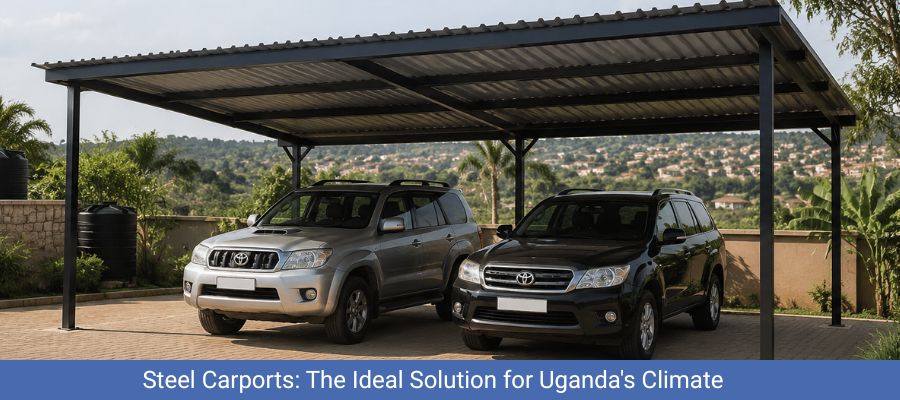
Uganda’s climate presents a dual challenge for parked vehicles: intense equatorial sun that degrades paint, dashboard plastics, and rubber seals, and heavy seasonal rains that — combined with the sun — accelerate corrosion and leave vehicles permanently dusty or mud-spattered. A steel carport addresses both threats with a durable, low-maintenance structure that keeps vehicles protected year-round.
Beyond vehicle protection, a well-designed steel carport from Build Matt adds real estate value to residential and commercial properties, provides a sheltered loading and unloading area, can integrate solar panels for green energy generation, and creates a visually impressive entry statement for homes and business premises. The entire installation process — from initial enquiry to completed handover — is designed to be straightforward, transparent, and minimally disruptive to your property.
Stage 1: Initial Enquiry and Site Assessment
The carport installation process begins with Build Matt’s site assessment visit. Our project team will:
- Measure the available space: Record the exact dimensions available for the carport, including any obstacles such as trees, boundary walls, gates, drainage channels, or underground utilities.
- Assess the ground conditions: Identify the existing surface (existing concrete slab, murram, soil) and determine what foundation work is required for the carport columns.
- Establish the number of bays and vehicle clearance: A standard single-car carport bay is 3.0 m wide × 5.5 m deep. A double-car bay is 5.5–6.0 m wide × 5.5 m deep. Larger multi-bay carports for commercial and institutional use are custom dimensioned.
- Discuss roof style and material: Flat roof (suitable for Kampala’s relatively low-wind conditions), mono-pitch (single slope), or dual-pitch (apex) roof profile. Roofing material options include gauge-30 coloured iron sheet, long-span profiled roofing, clear polycarbonate sheets (for natural light), or a combination of opaque and translucent panels.
- Address drainage and gutter requirements: In Uganda’s heavy rains, effective guttering and downpipe routing from a carport roof is essential to prevent water from flowing back toward the building or creating erosion near the foundation.
Build Matt provides a site visit report and preliminary design concept within 3–5 working days of the site visit.
Call Now for Quick Support
 Call Now!
Stage 2: Design, Quotation, and Permit Guidance
Following the site assessment, Build Matt’s design team prepares:
- Architectural sketch drawings showing the carport plan, elevation, and roof profile — for client approval and, where required, KCCA planning approval.
- Structural calculations confirming the column sizes, roof beam sections, and foundation dimensions required to safely resist wind and roof loads.
- Material specification: Steel section sizes (typically 100×100mm SHS columns and 100×50mm RHS roof beams for residential carports), roofing specification, and surface treatment specification.
- Detailed cost quotation with breakdown by foundation, structural steel, roofing, guttering, and finishing items.
For carports attached to residential homes in Kampala, a planning permit from KCCA is required if the structure exceeds certain size thresholds. Build Matt guides clients through the permit application process and provides all required drawings and structural documents.
Timeline: Design, quotation, and permit: 1–2 weeks.
Our Other Product
Water & Storage Tanks, Steel Silos & HoppersStage 3: Site Preparation and Foundation Work
With design approved and materials ordered, site preparation begins. This is the most critical stage of the carport installation process because the entire structure’s stability depends on the quality of its foundation.
Marking Out
Build Matt’s installation team marks the exact column positions on the ground using steel pins and a builder’s line, cross-checking diagonals to ensure the layout is perfectly square and aligned with the building and boundary.
Excavation
Column foundation holes are excavated to the specified depth — typically 600 mm to 900 mm deep for residential carport columns in Kampala’s clay-rich soils. Deeper foundations of 900 mm to 1,200 mm are required for larger commercial carport structures or for sites with weak or waterlogged ground conditions.
Blinding and Formwork
A 75 mm lean concrete blinding layer is placed at the bottom of each foundation hole to provide a clean, level base. Timber formwork is set around each foundation hole to define the above-ground portion of the column base.
Anchor Bolt Setting
Hot-dip galvanized anchor bolts (typically M16 or M20 depending on column size) are set in the wet concrete of each foundation pad at the exact positions and projection heights required for the column base plates. Getting anchor bolt placement right at this stage is critical — incorrectly placed bolts are extremely difficult to correct after the concrete has cured.
Concrete Casting
Foundation pads are cast in minimum Grade 25 concrete (25 MPa compressive strength). Build Matt uses site-mixed concrete with a controlled water-cement ratio to achieve the required strength. Foundation concrete is cured for a minimum of 7 days before column erection begins.
Timeline: Site preparation and foundation: 3–5 days (plus 7-day concrete cure).
Step 4: Crafting the Treads
Treads can be fabricated from solid steel plates, open gratings, or even steel pans designed to be filled with concrete or topped with timber.
- For modular staircases, treads are often fabricated as independent units that bolt onto a central spine stringer.
- For a spiral staircase, treads are usually “pie-shaped” and welded to a central sleeve that slides over the main pole.
Stage 4: Structural Steel Erection
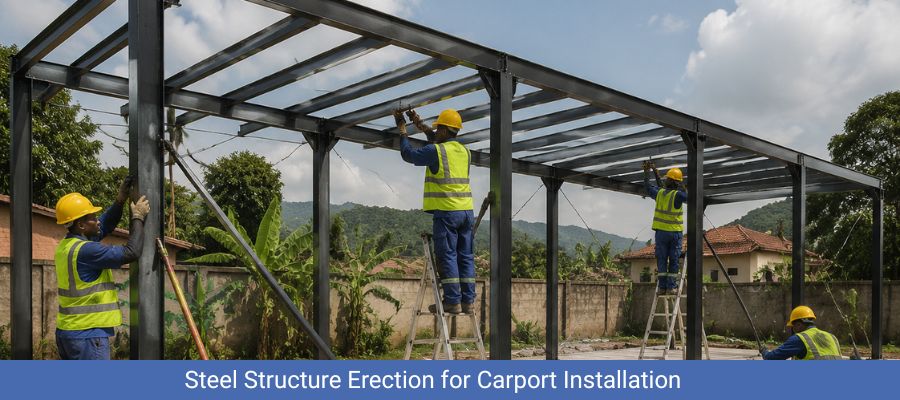
With foundations cured and anchor bolts confirmed correct, Build Matt’s erection team installs the carport steel structure:
- Columns are plumbed vertical using a spirit level or laser level and bolted to the anchor bolts on the base plate. Each column is temporarily braced with diagonal props to hold it plumb during the erection sequence.
- Primary roof beams (rafters or purlins spanning between columns) are lifted and bolted or welded to the column head brackets. Build Matt uses pre-fabricated beam-to-column connections for speed and accuracy.
- Secondary roof members (purlins) are installed spanning between the primary beams at the spacing required for the chosen roofing material — typically 900 mm to 1,200 mm for corrugated iron sheet.
- Diagonal bracing is installed in the roof plane and along the column lines to complete the three-dimensional structural stability of the carport frame.
- All bolted connections are tightened to the specified torque. All welded connections are inspected for weld quality and completeness.
Timeline: Steel erection: 1–2 days for residential carports. Larger commercial carports: 2–5 days.
Our Other Product
Container Offices & Homes - Modern Modular SpacesStage 5: Roofing Installation
Build Matt installs the specified roofing system over the completed steel frame:
- Corrugated or profiled iron sheet roofing: Sheets are fixed to the purlins with self-drilling roofing screws with neoprene washers to prevent leaks. Sheets are lapped by a minimum of one-and-a-half corrugations at side laps and 150 mm at end laps. Sheet fixing follows Uganda’s prevailing wind direction to minimise the risk of wind uplift at lap joints.
- Polycarbonate sheet roofing: Provides natural light through the carport roof — popular for home carports where owners want daylight inside the covered area. Build Matt supplies twin-wall and multi-wall polycarbonate panels in clear, opal, and bronze tints. Polycarbonate sheets are fixed with purpose-made aluminium capping profiles that allow thermal expansion without cracking.
- Combined opaque and translucent roofing: The most popular residential carport roofing design in Kampala — alternating coloured iron sheet bays with clear polycarbonate bays for a bright, attractive, and well-lit covered parking space.
Stage 6: Guttering, Drainage, and Finishing
Effective rainwater management is essential for all carports in Uganda. Build Matt installs:
- Aluminium box gutters along the lower edges of the carport roof to collect rainwater.
- Round or square aluminium downpipes routing water to the nearest drain, soakaway, or rainwater collection tank.
- Splash pads at downpipe outlets to prevent soil erosion.
Finishing works include touch-up painting of any steel surfaces scratched during erection, cleaning and removal of all construction waste from the site, and a thorough inspection of all fixings, roofing screws, and guttering connections.
Stage 7: Final Handover and Documentation
Build Matt provides clients with a final handover package including:
- As-built sketch showing the completed carport dimensions and column positions.
- Surface treatment confirmation (galvanizing specification or paint system used).
- Roofing material product documentation including warranty details for polycarbonate sheets.
- Maintenance notes covering recommended annual inspection and touch-up programme.
Total typical installation timeline for a residential double-car carport: 3 to 4 weeks from site assessment to final handover.
We are Responsive
Contact Us!
Frequently Asked Questions (FAQs)
A standard residential double-car steel carport typically takes 3 to 4 weeks from site assessment to final handover, including foundation curing time. Commercial multi-bay carport structures may take 5 to 8 weeks depending on size and site complexity. Build Matt provides a detailed project timeline at quotation stage.
A planning permit from KCCA is required for carports that exceed certain size thresholds or are attached to a building requiring a building permit. Build Matt guides clients through the permit application process and provides all required drawings and structural documents. For smaller standalone carports, a permit may not be required, but Build Matt will advise on the specific requirements for your site.
The most popular and practical choice is gauge-30 long-span profiled coloured iron sheet for the main roof area, combined with twin-wall polycarbonate panels for natural light. This combination provides durability, weather resistance, and a bright covered parking space. For a premium appearance, long-span standing seam metal roofing or all-polycarbonate roofing are available options.
For standard residential carport columns in Kampala's clay soils, foundations should be excavated to 600 mm to 900 mm depth and cast in Grade 25 concrete. Larger or taller commercial carport structures require deeper foundations of 900 mm to 1,200 mm. Build Matt's structural engineers specify foundation dimensions for each project based on column loads and local ground conditions.
Yes. Build Matt's carport structures can be designed to support the additional load of photovoltaic solar panels. The structural design is uprated to account for the panel weight and wind loads. Solar carports are an increasingly popular choice in Uganda as electricity costs rise and solar technology becomes more accessible. Contact Build Matt for a solar carport design consultation.
Build Matt treats all carport structural steel with hot-dip galvanizing as the primary corrosion protection — providing 20–30 years of rust protection in Uganda's tropical climate. This is followed by powder coating in the client's choice of RAL colour for the desired aesthetic finish. For budget projects, a zinc-rich primer plus polyurethane topcoat paint system is offered as an alternative.

Founder & CEO
Mukesh Patel is the Founder & CEO of Build Matt ltd, specializing in Pre-Engineered Buildings (PEB) and general steel fabrication. With advanced technology, modern machinery, and a skilled workforce, he delivers efficient and high-quality solutions across East and Central Africa, including Uganda, Kenya, Tanzania, Congo, South Sudan, Rwanda, and Burundi.
Recent Blogs
- Metal Stairs and Railings for Industrial Facilities: Safety, Design and Installation Considerations
- Free Standing Mezzanines vs Building Supported Mezzanines: Which Solution Is Right for Your Warehouse?
- Steel Industrial Rack vs Commercial Rack: Understanding the Key Differences for Businesses
- How to Design a Car Parking Structure for Multiple Vehicles and Maximum Space Efficiency
- How to Choose the Right Shade Structure for Balconies, Windows and Outdoor Spaces