
Read Our Article
How to Choose the Right Railing Height and Baluster Spacing for Indoor StaircasesSteel Staircase Railings for Schools, Hospitals, and Public Buildings in Uganda: Safety Standards & Design
April 30, 2026
Share At:




Listening Article
AI Summary
Steel staircase railings in Uganda’s public buildings—schools, hospitals, government offices, courts, universities, and community facilities-must satisfy strict safety, accessibility, and durability requirements that go beyond those for residential applications. This article by Build Matt Ltd. covers Uganda’s applicable safety standards for staircase railings, design principles for accessible and child-safe railings, material selection for high-traffic institutional environments, maintenance considerations, and specific design guidance for different facility types. With Uganda’s growing investment in public infrastructure, this guide serves architects, quantity surveyors, contractors, and institutional facility managers who need staircase railing solutions that meet professional and regulatory standards.
Introduction: The Critical Role of Staircase Railings in Uganda's Public Buildings
Uganda’s government, NGO community, faith-based organisations, and private sector are investing billions of shillings in new and renovated schools, hospitals, universities, government offices, courts, and community centres across the country. These public buildings serve diverse populations—including children, elderly people, patients, people with physical disabilities, and visitors unfamiliar with the building layout—who depend on staircase railings not just as a convenience but as an essential safety feature.
In Uganda’s public building context, a staircase railing failure is not merely a maintenance problem—it is a life-safety risk and a serious liability for the institution that owns the building. Poorly designed or maintained staircase railings contribute to falls, which are a leading cause of serious injury and death in institutional settings worldwide.
Build Matt Ltd. has designed, fabricated, and installed steel staircase railings and steel balustrades for schools, hospitals, government buildings, universities, banks, and commercial institutions across Uganda for over two decades. This guide shares the safety standards, design principles, and practical knowledge that institutional clients need to specify and procure staircase railings that protect the people who use their buildings.
Let’s Discuss! Request a Call Now!
 Call Now!
Applicable Safety Standards for Staircase Railings in Uganda
Uganda’s public buildings are subject to building regulations administered by Kampala Capital City Authority (KCCA) for buildings in Kampala and by district local governments elsewhere. While Uganda’s building code continues to develop, the internationally recognised standards most commonly referenced for staircase railing design in Uganda’s institutional buildings include:
- Uganda’s Building Code: Specifies minimum railing heights and structural requirements for public buildings.
- British Standards (BS 6180: Barriers in and around buildings): Widely referenced for railing load requirements, geometric design, and testing.
- ISO standards for accessibility (ISO 21542): Provides guidance on handrail design for people with disabilities, including dimensions for continuous handrails on stairs.
- Americans with Disabilities Act (ADA) guidelines: Referenced for handrail continuity, cross-section dimensions, and extension requirements, particularly for donor-funded institutional projects.
Key minimum requirements for staircase railings in Uganda’s public buildings:
- Minimum handrail height: 900 mm to 1,000 mm above the pitch line of the staircase (measured vertically from the stair nosing to the top of the handrail).
- Baluster spacing: Maximum 100 mm clear gap between balusters or infill elements to prevent children from passing through or becoming trapped.
- Structural load capacity: Railings in public buildings must withstand a horizontal concentrated load of 0.74 kN at any point on the top handrail, and a uniformly distributed horizontal load of 0.74 kN/m along the full length.
- No horizontal elements below 900 mm: Horizontal bars, rails, or decorative elements that could serve as climbing footholds for children are prohibited below 900 mm height in school and children’s facility railings.
- Handrail continuity: Handrails should be continuous along the full length of the stair flight, with extensions at the top and bottom of each flight where accessibility requirements apply.
Design Principles for Institutional Staircase Railings in Uganda
Safety First: Structural Integrity and Geometry
In public buildings, staircase railings must be engineered—not estimated. Build Matt’s structural engineers calculate the required post sizes, base plate dimensions, and fixing specifications for every institutional railing installation based on the specific staircase geometry, railing height, and design load requirements. Common failure points in poorly designed public building railings include:
- Undersized base plates or anchor bolts that pull out of the stair slab under horizontal loading
- Balusters welded to the handrail and base rail without adequate section size, leading to bending failure under impact
- Inadequate welding at post-to-base-plate connections, leading to progressive failure under repeated use
Build Matt’s institutional railing designs are reviewed by qualified structural engineers and fabricated to drawings with full weld specifications.
Accessibility: Designing for All Users
Uganda’s public institutions serve people with a wide range of physical abilities. For hospital, clinic, and disability-inclusive school facilities, staircase railings must incorporate:
- Continuous handrails at two heights: 900 mm for ambulant adults and 650–750 mm for wheelchair users, children, or people of short stature. Dual-height handrails are increasingly required for government facilities, hospitals, and universities in Uganda.
- Handrail cross-section: Circular or oval handrail profiles with an outer diameter of 32 mm to 50 mm allow a firm, comfortable grip. Square or flat handrail sections do not allow the same grip security and are not recommended for high-use institutional staircases.
- Handrail extensions: At the top of a staircase flight, the handrail should extend horizontally for a minimum of 300 mm beyond the last riser. At the bottom, the handrail should extend at stair slope for one tread depth beyond the bottom riser.
- No sharp edges or projections: All railing ends must be returned to the wall or post to prevent clothing snagging or injuries to partially sighted users.
Material Selection for Uganda’s Institutional Environments
The choice of railing material for Uganda’s public buildings must balance durability, safety, hygiene, maintenance requirements, and budget. Build Matt’s recommendations for different institutional environments:
- Hospitals and health facilities: Stainless steel grade 316 balustrades and handrails are the preferred specification for hospital staircase railings in Uganda. Stainless steel is non-porous, easy to clean and disinfect, resistant to the cleaning chemicals used in healthcare environments, and has no coating that can chip and contaminate clinical areas. For budget-constrained facilities, mild steel with epoxy powder coating in a smooth, cleanable finish is the minimum acceptable specification.
- Schools and universities: Hot-dip galvanized mild steel with powder coating in a robust, impact-resistant finish is the standard specification for school staircase railings in Uganda. Specify a minimum 80 micron powder coat for high-traffic school environments. Dark colours (black, charcoal, navy blue) are recommended as they show less scuff marks and damage than light colours.
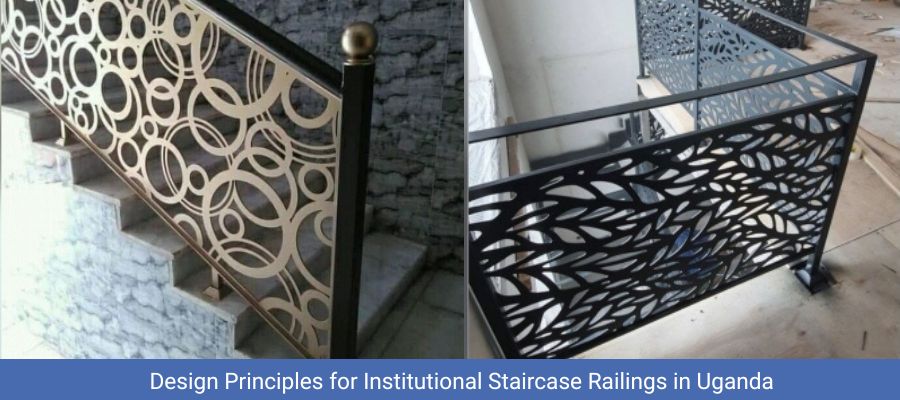
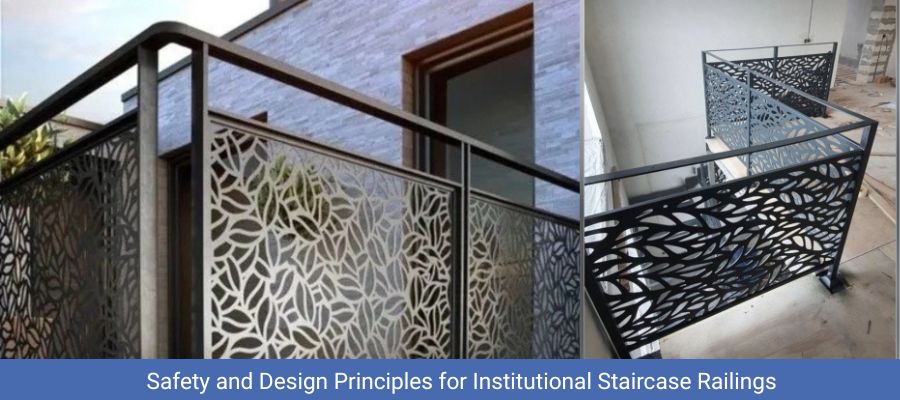
- Government offices and courts: Stainless steel brushed finish (grade 304) or powder-coated mild steel in official colours. For prestigious government buildings and courthouses, Build Matt recommends stainless steel balustrades with decorative laser-cut panels to reflect the institutional character.
- Community facilities and places of worship: Powder-coated mild steel with galvanized base treatment provides an excellent balance of durability and cost for churches, mosques, community halls, and social welfare facilities across Uganda.
Our Other Product
Container Offices & HomesBaluster Design for Child Safety in Schools and Paediatric Facilities
Special attention to baluster design is required for staircase railings in Uganda’s schools, nurseries, and paediatric hospital wards. Key requirements:
- No horizontal bars below 900 mm height: Horizontal bars at child-height create a ladder-like structure that invites climbing. Use vertical balusters only below 900 mm in school and children’s facility railings.
- Maximum 100 mm baluster spacing: The clear gap between adjacent balusters must not exceed 100 mm. This prevents children from passing their head through the baluster gap, which can cause entrapment and strangulation risk.
- Smooth balusters without horizontal projections: Avoid decorative elements, scrollwork, or horizontal tie bars that could catch clothing or provide hand or footholds for climbing.
- Robust post fixing: In school environments, railings are subjected to far higher lateral forces than in most buildings due to children leaning, swinging, and playing on railings. Build Matt specifies increased post sizes and base plate dimensions for school railings to account for this.
Read Our Article
Steel Staircase Fabrication: A Step-by-Step Engineering ManualMaintenance of Steel Staircase Railings in Uganda's Public Buildings
Institutional facility managers in Uganda should establish a formal staircase railing maintenance programme:
- Quarterly visual inspection: Check all railing posts, handrails, and balusters for loose fixings, damaged welds, coating damage, and corrosion. Pay particular attention to post base plates, which are vulnerable to water ingress and base-level corrosion.
- Six-monthly structural check: Apply a lateral test load to each post by hand to check for movement at the base fixing. Any movement indicates loosening of anchor bolts or corrosion of base plates—repair immediately.
- Annual cleaning and recoating: Wash all railing surfaces with a mild detergent, rinse thoroughly, and treat any areas of coating damage with zinc-rich primer and touch-up paint. In hospitals, quarterly cleaning with approved clinical disinfectants is standard.
- Five-year comprehensive inspection: Commission a structural engineer or qualified inspector to review the complete staircase railing installation for compliance with current standards and structural adequacy.
We are Fast in Response
Contact Now!
Build Matt Ltd.: Uganda's Institutional Steel Railing Specialist
Build Matt Ltd. has delivered steel staircase railings, steel balustrades, and stainless steel handrail systems to Uganda’s leading schools, hospitals, banks, government buildings, and commercial institutions for over twenty years. Our institutional railing projects include facilities for Bank of Baroda Uganda, Crane Bank, Orient Bank, Kampala Pharmaceutical Industries, Rwenzori Beverages, and numerous school and healthcare facility projects across Uganda and the wider East African region.
Build Matt’s institutional railing service covers structural engineering design, shop fabrication to drawings, hot-dip galvanizing or stainless steel construction, professional site installation, and handover documentation. Contact Build Matt’s Kampala office for a free institutional railing consultation and quotation.
Our Other Product
Water & Storage Tanks, Steel Silos & HoppersFrequently Asked Questions (FAQs) on Steel Staircase Railings
Uganda's building standards, aligned with British Standard BS 6180, require a minimum handrail height of 900 mm measured vertically from the stair pitch line to the top of the handrail for public buildings. For accessibility-compliant facilities, a second lower handrail at 650 to 750 mm is recommended for wheelchair users and children.
The maximum clear gap between balusters is 100 mm. This dimension prevents most children from passing their head through the baluster gap. In schools and paediatric facilities, Build Matt recommends a maximum clear gap of 90 mm as an additional safety margin.
Stainless steel is not legally mandatory in Uganda but is strongly recommended for hospital and healthcare facility staircase railings. Stainless steel grade 316 is non-porous, easy to disinfect, and resistant to hospital cleaning chemicals—properties that mild steel powder-coated railings cannot match over the long term. Build Matt recommends stainless steel for all health facility railing applications.
Yes. Build Matt provides full structural design calculations, fabrication drawings, and material certificates for institutional railing projects. These documents are suitable for submission to KCCA or district building authorities as part of building permit applications.
Stainless steel railings typically cost two to three times more than equivalent hot-dip galvanized mild steel railings with powder coating. However, over a 20-year building lifespan, the elimination of repainting costs and the superior durability of stainless steel often make it the more economical choice for well-funded institutional projects. Build Matt can provide life-cycle cost comparisons for both options.
For a standard two-storey school or hospital building, Build Matt typically requires two to four weeks from design confirmation to completed site installation, depending on the number of staircase flights and railing complexity. Stainless steel systems may have longer lead times due to material procurement. Build Matt provides a detailed project schedule at quotation stage.

Founder & CEO
Mukesh Patel is the Founder & CEO of Build Matt ltd, specializing in Pre-Engineered Buildings (PEB) and general steel fabrication. With advanced technology, modern machinery, and a skilled workforce, he delivers efficient and high-quality solutions across East and Central Africa, including Uganda, Kenya, Tanzania, Congo, South Sudan, Rwanda, and Burundi.
Recent Blogs
- Metal Stairs and Railings for Industrial Facilities: Safety, Design and Installation Considerations
- Free Standing Mezzanines vs Building Supported Mezzanines: Which Solution Is Right for Your Warehouse?
- Steel Industrial Rack vs Commercial Rack: Understanding the Key Differences for Businesses
- How to Design a Car Parking Structure for Multiple Vehicles and Maximum Space Efficiency
- How to Choose the Right Shade Structure for Balconies, Windows and Outdoor Spaces