When planning the electrical infrastructure for a building project in Uganda—whether a warehouse in Namanve Industrial Park, a commercial office in Kampala, or a manufacturing plant in Jinja—one of the earliest and most consequential decisions is how to route and protect electrical cables. The two most common options are cable trays and cable conduits. While both serve the fundamental purpose of organising and protecting electrical cables, they differ significantly in design, cost, performance, and suitability for different environments.
Build Matt Ltd., Uganda’s leading manufacturer of steel cable trays and electrical cable management systems, has helped hundreds of contractors, engineers, and project managers make this decision over two decades. This guide provides a clear, practical comparison to help you choose the right system for your specific project.
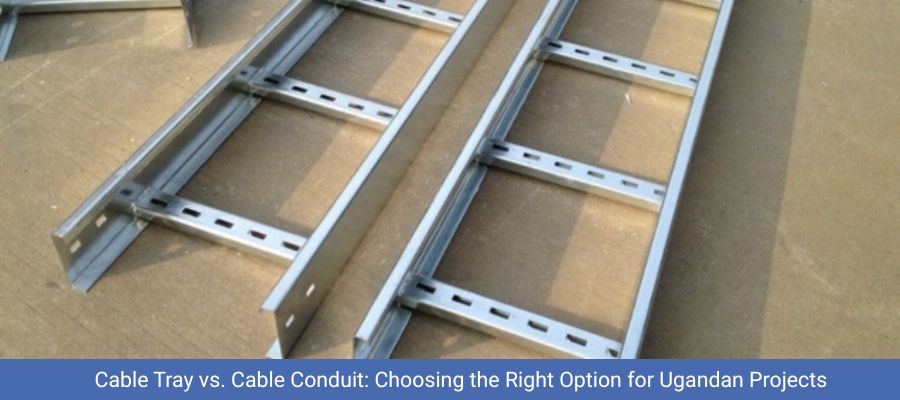
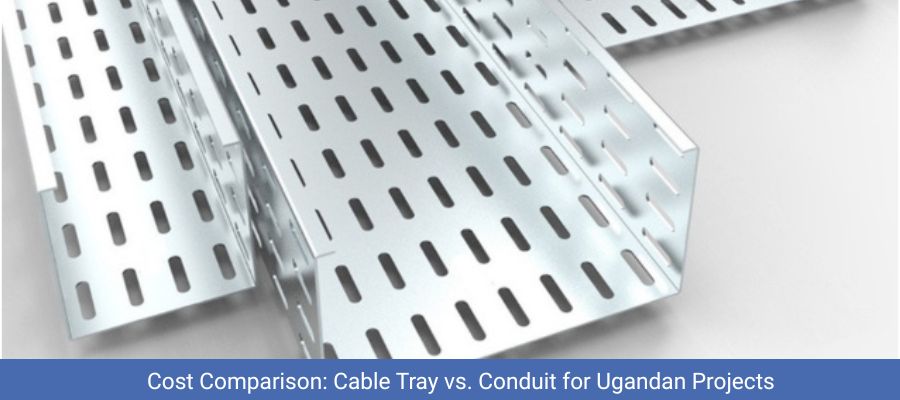
An electrical cable tray is an open or semi-open support structure used to hold, organise, and route electrical cables through a building or industrial facility. Cable trays are available in several types:
Cable trays are typically used for long cable runs in open ceiling spaces, warehouses, factories, and industrial facilities where accessibility and scalability are priorities.
A cable conduit is a fully enclosed tube or pipe—made from PVC, galvanized steel, or aluminium—through which electrical cables are threaded. Unlike cable trays, conduits completely enclose the cables, offering higher physical protection. Conduit types used in Uganda include:
Conduits are typically used for shorter cable runs, concealed wiring in walls and slabs, and situations where cables require maximum physical protection.
Cable trays generally offer a lower installed cost per metre for large-scale cable management projects. A galvanized steel cable tray in Uganda can accommodate dozens of cables simultaneously, spreading the material and installation cost across many circuits. In contrast, each cable in a conduit system requires its own conduit run, significantly increasing material costs for multi-cable installations.
For a large warehouse or factory with 50 or more cable circuits, cable trays can reduce cable management costs by 40 to 60% compared to an equivalent conduit installation.
Cable trays are faster to install for large-scale projects. Tray sections are simply bolted together and mounted on support brackets. Adding or modifying cables after installation is straightforward—cables are simply laid into the open tray. Conduit installations require careful pre-planning, threading cables through enclosed pipes, and making cable pulls—which becomes progressively more difficult as conduit runs increase in length or number of bends.
Cable trays are far superior for scalability. Adding new cables to an existing cable tray simply requires laying the new cable into the tray. With conduit systems, adding new cables often requires pulling new conduits—a disruptive and expensive process in an operational facility. This makes cable trays the preferred choice for Ugandan industrial facilities that plan to expand operations in the future.
Open cable trays—especially ladder cable trays and perforated cable trays—allow natural airflow around cables, significantly reducing operating temperatures. This is particularly important in Uganda’s warm climate, where cable temperatures directly affect cable current-carrying capacity (ampacity) and lifespan. Conduits, being fully enclosed, trap heat around cables, which can derate cable ampacity and shorten cable life.
Conduits offer superior physical protection against impact, abrasion, chemical exposure, and vermin. For cables routed through walls, floors, or areas with high traffic and physical hazard risk, conduits are the safer choice. In warehouse environments, partially exposed cable runs in ceiling areas where fork-lift trucks or other equipment cannot reach are well served by open cable trays.
Galvanized steel cable trays manufactured by Build Matt Ltd. are specifically designed for Uganda’s tropical environment. The hot-dip galvanizing process provides a zinc coating that resists corrosion for 20 to 30 years even in high-humidity conditions. PVC conduit can become brittle and crack under prolonged UV exposure in Uganda’s sun, while steel conduit without galvanizing will corrode rapidly in humid areas. For long-term, low-maintenance cable management in Ugandan industrial and commercial buildings, galvanized cable trays are the optimal choice.
Many of Build Matt’s most successful industrial projects in Uganda use both cable trays and conduit in a complementary system. Cable trays handle the long main cable runs through the facility—typically along the ceiling or elevated on wall-mounted brackets—while conduits drop cables down from the tray to individual machines, panels, and equipment. This hybrid approach combines the cost efficiency and scalability of cable trays with the physical protection of conduit at vulnerable points.
Build Matt Ltd. manufactures the full range of steel cable trays, galvanized cable trays, wire mesh cable trays, perforated cable trays, and flexible cable trays for Uganda’s industrial and commercial market. We also supply a complete range of cable tray accessories including cable tray elbows, tees, bends, crosses, support brackets, and cable tray covers. With over two decades of experience serving Uganda’s leading construction companies, oil firms, banks, and pharmaceutical companies, Build Matt delivers cable management solutions that are built to last in Africa’s demanding environments.
Yes. For large-scale industrial projects with many cable circuits, cable trays are typically 40 to 60% cheaper than an equivalent conduit installation because a single tray can carry dozens of cables simultaneously. Build Matt Ltd. offers competitively priced galvanized steel cable trays fabricated in Kampala for fast local delivery.
Absolutely. A hybrid approach is the most common and practical solution for Ugandan industrial and commercial buildings. Cable trays handle the long main cable runs, while conduit provides protected connections from the tray to individual machines, panels, and equipment.
Wire mesh cable trays (basket trays) are ideal for data and communication cables. They are lightweight, easy to modify, and provide excellent airflow. For server rooms and data centres, Build Matt recommends stainless steel wire mesh cable trays for maximum corrosion resistance.
Build Matt's hot-dip galvanized steel cable trays are designed to last 20 to 30 years in Uganda's tropical environment with minimal maintenance. The zinc galvanizing layer provides a physical and electrochemical barrier against corrosion, making galvanized cable trays the most durable option for humid Ugandan industrial facilities.
Yes. Build Matt manufactures and supplies a complete range of cable tray accessories including elbows, tees, bends, cross-overs, splice plates, support brackets, cable tray covers, and end caps. All accessories are available in matching finishes to the primary tray system.

Founder & CEO
Mukesh Patel is the Founder & CEO of Build Matt ltd, specializing in Pre-Engineered Buildings (PEB) and general steel fabrication. With advanced technology, modern machinery, and a skilled workforce, he delivers efficient and high-quality solutions across East and Central Africa, including Uganda, Kenya, Tanzania, Congo, South Sudan, Rwanda, and Burundi.